
300-615 · Question #248
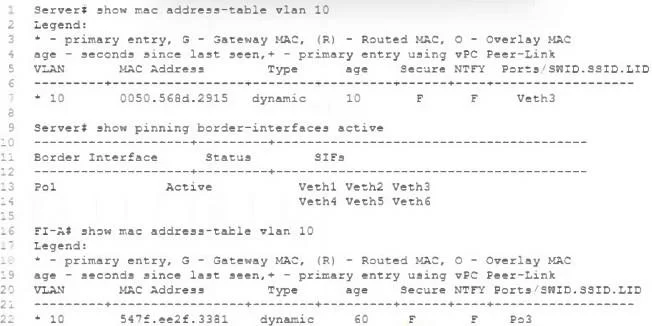
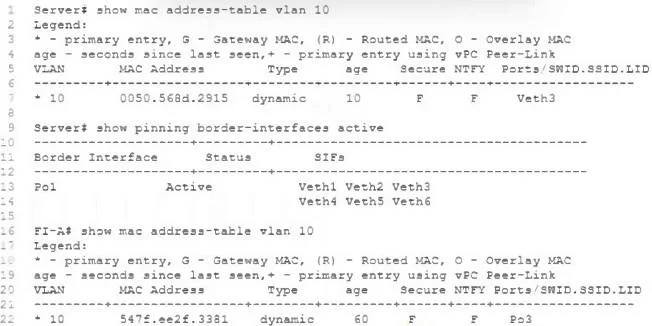
Refer to the exhibit. An engineer analyzes the packet flow in a Cisco UCS domain that consists of Cisco UCS Fabric Interconnects. The engineer discovers that the virtual machine traffic goes through…
The correct answer is B. Allow VLAN 10 on FI-A. The issue is that traffic is expected to go through Cisco Fabric Interconnect A (FI-A), but it is going through FI-B instead. When you check the MAC address table on both fabric interconnects, you see that VLAN 10 is present on FI-B but not on FI-A. This indicates that VLAN 10…
Question
Refer to the exhibit. An engineer analyzes the packet flow in a Cisco UCS domain that consists of Cisco UCS Fabric Interconnects. The engineer discovers that the virtual machine traffic goes through Cisco Fabric Interconnect B, but the traffic is expected to go through Cisco Fabric Interconnect A. Which action resolves the issue?
Exhibits
Options
- APlug the uplink cable into a different port
- BAllow VLAN 10 on FI-A
- CPlug the server cable into a different port
- DAllow VLAN 10 on FI-B
How the community answered
(34 responses)- A3% (1)
- B85% (29)
- C3% (1)
- D9% (3)
Explanation
The issue is that traffic is expected to go through Cisco Fabric Interconnect A (FI-A), but it is going through FI-B instead. When you check the MAC address table on both fabric interconnects, you see that VLAN 10 is present on FI-B but not on FI-A. This indicates that VLAN 10 is not allowed or not configured on FI-A, which is why the traffic is being forwarded through FI-B. To resolve this issue, you need to allow VLAN 10 on FI-A, so that traffic can flow through the correct path (FI-A) as expected.
Topics
Community Discussion
No community discussion yet for this question.