
300-610 · Question #278
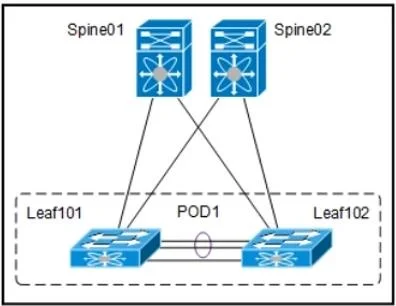
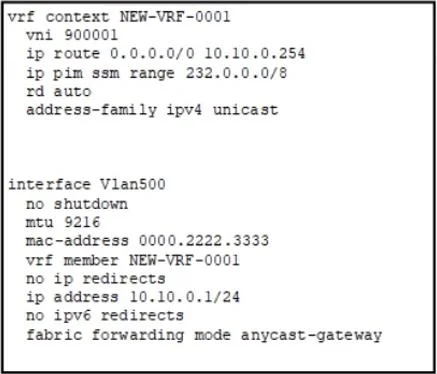
Refer to the exhibit. An engineer must deploy NEW-VRF-001 in the data center. All hosts require full reachability with all other hosts, no matter on which pod the host deployment occurs. Which set…
The correct answer is D. route-target both auto evpn. To deploy a new VRF in a data center and ensure full reachability between all hosts across pods in an EVPN-VXLAN environment, route targets must be configured to allow automatic EVPN route exchange.
Question
Refer to the exhibit. An engineer must deploy NEW-VRF-001 in the data center. All hosts require full reachability with all other hosts, no matter on which pod the host deployment occurs. Which set of commands must the engineer include in the deployment?
Exhibits
Options
- Ahost-reachability protocol bgp
- Baddress-family I2vpn evpn
- Cadvertise I2vpn evpn
- Droute-target both auto evpn
How the community answered
(51 responses)- A4% (2)
- B14% (7)
- C10% (5)
- D73% (37)
Why each option
To deploy a new VRF in a data center and ensure full reachability between all hosts across pods in an EVPN-VXLAN environment, route targets must be configured to allow automatic EVPN route exchange.
`host-reachability protocol bgp` is a command for defining how host routes are learned, but it does not specify the mechanism for inter-pod VRF reachability through EVPN route targets.
`address-family l2vpn evpn` enables the EVPN address family within BGP, but it does not configure the specific route-target policy required for consistent, automatic route exchange across VRFs and pods.
`advertise l2vpn evpn` is used to instruct BGP to advertise EVPN routes, but it is not the primary command for establishing the automatic and pervasive VRF reachability provided by route targets.
The command `route-target both auto evpn` configured under a VRF in an EVPN-VXLAN environment enables the automatic generation and exchange of EVPN route targets for the VRF. This ensures that IP prefix routes and MAC/IP advertisement routes (Type 5 and Type 2) associated with the VRF are correctly imported and exported across all VTEPs in the data center fabric, guaranteeing full reachability for all hosts within that VRF, regardless of their physical location or pod.
Concept tested: EVPN-VXLAN VRF route-target configuration
Source: https://www.cisco.com/c/en/us/td/docs/dcn/nx-os/nexus9000/102x/configuration/evpn-vxlan/cisco-nexus-9000-series-nx-os-evpn-vxlan-configuration-guide-102x/m-configure-evpn-vxlan-l3-gateway.html
Topics
Community Discussion
No community discussion yet for this question.