
300-610 · Question #258
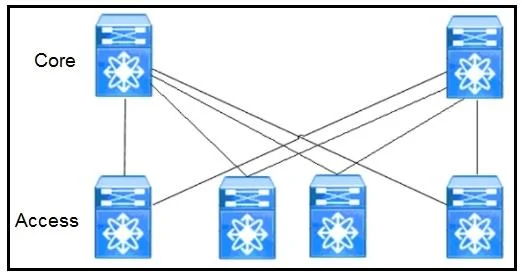
Refer to the exhibit. An engineer must migrate the current topology to a topology that provides more speed, less latency, and support for software-define networks. The new topology has these…
The correct answer is B. three-tier. The description of a network separated into core, aggregation, and access routers, supporting varied server-to-server latency, and allowing Layer 3 domain extension, aligns with a traditional three-tier architecture.
Question
Refer to the exhibit. An engineer must migrate the current topology to a topology that provides more speed, less latency, and support for software-define networks. The new topology has these requirements:
- separation into core, aggregation, and access routers
- varied server-to-server latency, depending on the path used
- support for extending the Layer 3 domain by combining access and
aggregation routers Which design topology meets these requirements?
Exhibit
Options
- Aflood-and-learn
- Bthree-tier
- Cspine-and-leaf
- Dcore-edge
How the community answered
(52 responses)- A33% (17)
- B46% (24)
- C13% (7)
- D8% (4)
Why each option
The description of a network separated into core, aggregation, and access routers, supporting varied server-to-server latency, and allowing Layer 3 domain extension, aligns with a traditional three-tier architecture.
"Flood-and-learn" describes a basic Layer 2 switching mechanism and is not a network design topology.
A three-tier topology explicitly segments the network into distinct core, aggregation (distribution), and access layers, providing a structured approach that can naturally introduce varied latency depending on the path taken. This architecture supports the extension of Layer 3 domains by routing at the aggregation or access layers and facilitates a clear evolution towards software-defined networks.
A spine-and-leaf architecture is designed for consistent, low-latency, two-hop communication (any-to-any) within a data center, which contradicts the requirement for varied server-to-server latency and the traditional core/aggregation/access separation.
Core-edge is a general network concept but does not provide the specific layered separation, varied latency, or explicit Layer 3 extension support as comprehensively as a three-tier model.
Concept tested: Network topology - Three-tier architecture
Source: https://www.cisco.com/c/en/us/td/docs/solutions/Enterprise/Campus/campover.html
Topics
Community Discussion
No community discussion yet for this question.