
300-610 · Question #225
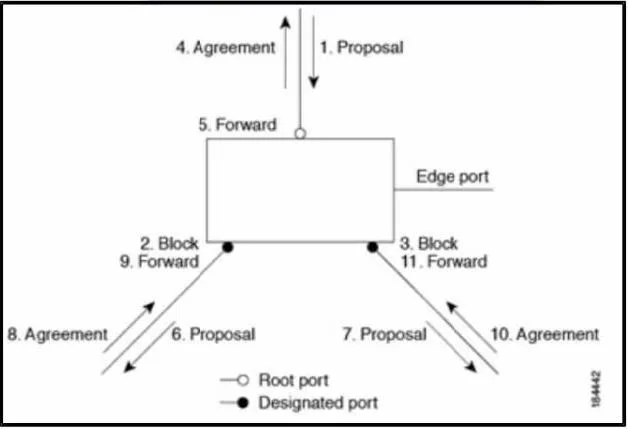
Refer to the exhibit. During a synchronization of port roles, a device receives a proposal message on one of its ports that is s selected as the new root port. The logs show that Rapid PVST+ forced…
The correct answer is A. It transitions to the blocking state. In Rapid PVST+, when a device synchronizes with new, superior root information received on its root port, a designated port (not an edge port) in a forwarding state will transition to the blocking state.
Question
Refer to the exhibit. During a synchronization of port roles, a device receives a proposal message on one of its ports that is s selected as the new root port. The logs show that Rapid PVST+ forced all other ports to synchronize with the new root information. The engineer analyzes the port states and concludes that the device is synchronized with superior root information received on the root port, and all other ports are synchronized. What happens to a designated port that is in the forwarding state and is not configured as an edge port, if Rapid PVST+ forces it to synchronize with new root information?
Exhibit
Options
- AIt transitions to the blocking state.
- BIt discards frames switched from another port.
- CIt does not receive BPDUs for transmission.
- DIt immediately replies with its own information.
How the community answered
(34 responses)- A82% (28)
- B9% (3)
- C3% (1)
- D6% (2)
Why each option
In Rapid PVST+, when a device synchronizes with new, superior root information received on its root port, a designated port (not an edge port) in a forwarding state will transition to the blocking state.
In Rapid PVST+ (RSTP), when a switch receives a superior BPDU on its root port, indicating a new root bridge, it must re-converge the spanning tree. Any designated port that is not an edge port and is currently in a forwarding state, upon synchronization with this new root information, will immediately transition to the blocking (or discarding) state to prevent temporary loops before eventually converging to its new role and state in the updated topology.
Discarding frames is part of the blocking state, but the primary action for the port is to transition its *state* to blocking, not just discard frames while remaining in forwarding.
A designated port transmits BPDUs; not receiving them for transmission would indicate a different port role or state, which is not the immediate effect of synchronization with new root information on a designated port.
Immediately replying with its own information would lead to a potential loop if the information is stale and the port does not first transition to a blocking state.
Concept tested: Rapid PVST+ designated port state transition
Source: https://www.cisco.com/c/en/us/td/docs/switches/lan/catalyst3750/software/release/12-2_35_se/configuration/guide/scg/swstp.html
Topics
Community Discussion
No community discussion yet for this question.