
300-610 · Question #140
Refer to the exhibit. Server 1 fails to connect to the storage array over the Storage Area Network (SAN) of the Cisco NDS 9000 Series Switch. The requirements are to redesign the storage network and…
The correct answer is A. Enable NPV and F-Port-channel on ports that face Server 1 on the Fibre Channel switch to create. To provide redundant and isolated server traffic that tolerates hardware/software failures and nondisruptive upgrades in a SAN, enable N-Port Virtualization (NPV) and F-Port-channel on the server-facing Fibre Channel switch ports.
Question
Refer to the exhibit. Server 1 fails to connect to the storage array over the Storage Area Network (SAN) of the Cisco NDS 9000 Series Switch. The requirements are to redesign the storage network and keep these considerations in mind:
The traffic from each of the server must be redundant and isolated. The design must tolerate hardware and software failures and upgrades of SAN fabric devices. Which action must be taken to meet these requirements?
Exhibit
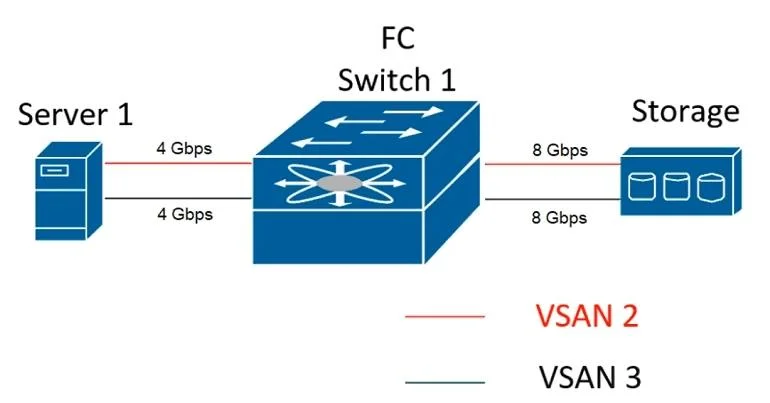
Options
- AEnable NPV and F-Port-channel on ports that face Server 1 on the Fibre Channel switch to create
- BCreate a SAN port channel that faces the storage device to sustain a link failure.
- CAdd an additional supervisor to the Fibre Channel switch to support nondisruptive upgrades.
- DPlace an additional Fibre Channel switch to create two physically independent storage fabrics.
How the community answered
(32 responses)- A59% (19)
- B25% (8)
- C9% (3)
- D6% (2)
Why each option
To provide redundant and isolated server traffic that tolerates hardware/software failures and nondisruptive upgrades in a SAN, enable N-Port Virtualization (NPV) and F-Port-channel on the server-facing Fibre Channel switch ports.
Enabling NPV and F-Port-channel on the ports facing Server 1 allows the Fibre Channel switch to operate in NPV mode, virtualizing server HBAs and aggregating them into a logical F-Port-channel towards the core fabric. This provides redundancy by bundling multiple physical links, isolates server traffic from the core fabric, and facilitates fault tolerance for hardware/software failures and nondisruptive upgrades by abstracting the server's connection.
Creating a SAN port channel that faces the storage device provides link redundancy for the storage array, but it does not address the server-side requirements for redundant and isolated traffic, nor does it inherently tolerate failures and upgrades of the SAN fabric devices connected to the server.
Adding an additional supervisor to the Fibre Channel switch enhances the switch's internal redundancy and supports nondisruptive supervisor upgrades, but it does not directly solve the problem of providing redundant and isolated server traffic paths across the SAN fabric.
Placing an additional Fibre Channel switch to create two physically independent storage fabrics is a method for fabric-level redundancy, but the question specifically asks for an action that addresses the server-side connection for Server 1 to meet the specified requirements, which NPV and F-Port-channel directly solve more effectively in this context.
Concept tested: Cisco SAN N-Port Virtualization (NPV) and F-Port-channel
Source: https://www.cisco.com/c/en/us/td/docs/switches/datacenter/mds9000/sw/5_0/configuration/guide/cfg_n_port_virtualization/npv_50/npv.html
Topics
Community Discussion
No community discussion yet for this question.