
300-515 · Question #83
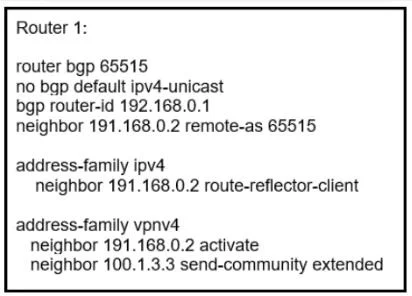
Refer to the exhibit. Router 1 is a route reflector client within a service provider core. PE1 cannot see VPNv4 routes received from the ASBR. PE1 only has an iBGP relationship with Router 1. Which…
The correct answer is B. Configure Router 1 as a route reflector for PE1 under the VPNv4 address family. Option B is correct because BGP route reflection is address-family specific in IOS - being configured as a route reflector client under the IPv4 unicast address family does not automatically extend to the VPNv4 address family. Router 1 must have route-reflector-client…
Question
Refer to the exhibit. Router 1 is a route reflector client within a service provider core. PE1 cannot see VPNv4 routes received from the ASBR. PE1 only has an iBGP relationship with Router 1. Which action resolves this issue?
Exhibit
Options
- AActivate PE1 as a neighbor under the IPv4 address family.
- BConfigure Router 1 as a route reflector for PE1 under the VPNv4 address family.
- CConfigure PE1 to have an eBGP relationship with Router 1.
- DEnable BGP default ipv4-unicast
How the community answered
(25 responses)- A12% (3)
- B80% (20)
- C4% (1)
- D4% (1)
Explanation
Option B is correct because BGP route reflection is address-family specific in IOS - being configured as a route reflector client under the IPv4 unicast address family does not automatically extend to the VPNv4 address family. Router 1 must have route-reflector-client explicitly configured for PE1 under address-family vpnv4, otherwise VPNv4 prefixes received from the ASBR are never reflected toward PE1.
Why the distractors fail:
- A - Activating PE1 under the IPv4 address family affects only IPv4 unicast routes, not VPNv4; it solves the wrong problem.
- C - PE1 and Router 1 are in the same AS (SP core), so eBGP is architecturally incorrect here and wouldn't fix VPNv4 reflection anyway.
- D -
bgp default ipv4-unicastauto-activates neighbors in the IPv4 unicast family; it has no bearing on VPNv4 route propagation.
Memory tip: Think of each BGP address family as a separate pipe - route reflection must be plumbed independently per pipe. If VPNv4 routes aren't flowing, ask "is the RR configured as route-reflector-client under vpnv4?" - that's almost always the culprit on SP exam scenarios.
Topics
Community Discussion
No community discussion yet for this question.