
300-515 · Question #14
Refer to the exhibit. PE1 and PE2 are exchanging VPNv4 routes for CE1 and CE2, and PE3 contains the default route to the internet. If the three devices are operating normally, which two conclusions…
The correct answer is A. The CE1 and CE2 VRFs can exchange routes only between their respective VRFs on PE1 and C. All three routers must be running MP-BGP. In MPLS L3VPN architecture, MP-BGP is the mandatory protocol for exchanging VPNv4 routes between PE routers - it's the only BGP variant that can carry the extended community attributes (Route Distinguishers and Route Targets) needed to distinguish and route between VPNs, making…
Question
Refer to the exhibit. PE1 and PE2 are exchanging VPNv4 routes for CE1 and CE2, and PE3 contains the default route to the internet. If the three devices are operating normally, which two conclusions describe this configuration? (Choose two.)
Exhibit
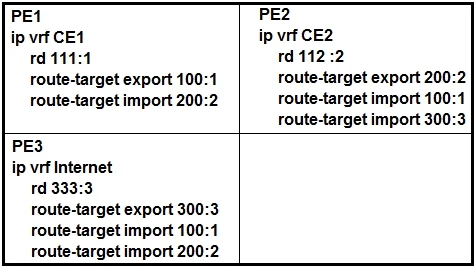
Options
- AThe CE1 and CE2 VRFs can exchange routes only between their respective VRFs on PE1 and
- BAll three routers must be running a distance-vector routing protocol.
- CAll three routers must be running MP-BGP.
- DThe CE1 and CE2 VRFs can access the default route provided by the Internet VRF.
- EOnly the CE2 VRF can access the default route provided by the Internet VRF.
How the community answered
(29 responses)- A79% (23)
- B7% (2)
- D3% (1)
- E10% (3)
Explanation
In MPLS L3VPN architecture, MP-BGP is the mandatory protocol for exchanging VPNv4 routes between PE routers - it's the only BGP variant that can carry the extended community attributes (Route Distinguishers and Route Targets) needed to distinguish and route between VPNs, making C definitively correct. A is correct because without explicit route leaking (importing the Internet VRF's route targets into CE1/CE2 VRFs), each VRF remains isolated and can only exchange routes with its peer VRF on the other PE - CE1's VRF talks only to CE1's VRF, and CE2's VRF talks only to CE2's VRF.
B is wrong because MP-BGP is a path-vector protocol, not distance-vector; the CE-PE links can use OSPF, EIGRP, static routes, or others, but no distance-vector requirement exists. D is wrong because accessing the Internet VRF's default route requires explicit route leaking (configured RT imports), which is not described as present here. E is wrong because nothing in the scenario privileges CE2 over CE1 - both VRFs face the same isolation without route leaking configured.
Memory tip: Think of VRFs as "walled gardens" - by default they only talk to their own matching VRF on remote PEs, and the key to "breaking out" to another VRF (like an Internet VRF) is always route target import/export leaking, not just connectivity. If leaking isn't mentioned, the walls stay up.
Topics
Community Discussion
No community discussion yet for this question.