
300-515 · Question #120
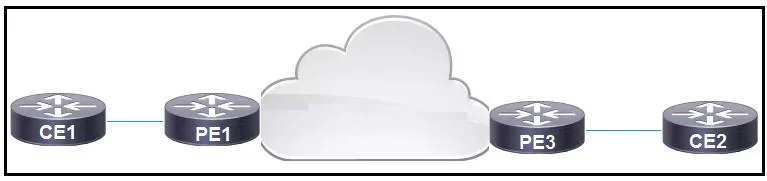
Refer to the exhibit. The networking team of the service provider configured an L3VPN within the service provider core to provide connectivity between a customer's two offices. BGP is configured as…
The correct answer is C. Implement the allowas-in feature on the CEs to bypass the BGP loop prevention mechanism and. Because each CE’s prefix arrives via the SP with its own AS (65515) already in the AS-PATH, the BGP loop-prevention check on the CE will reject it. Enabling neighbor X allowas-in on the CE’s BGP session with the PE lets it accept routes even if its AS appears in the AS-PATH.
Question
Refer to the exhibit. The networking team of the service provider configured an L3VPN within the service provider core to provide connectivity between a customer’s two offices. BGP is configured as the PE-CE routing protocol. The customer is using AS 65515, and the service provider is using AS 65516. After the L3VPN was established and BGP neighbor relationships were established at each customer site, the team determined that CE1 and CE2 cannot communicate. Which action must the team take to resolve the issue?
Exhibit
Options
- AConfigure the AS-Override feature on both CE routers so that they share routes with one another.
- BEnable BGP Split Horizon on the PEs to allow PE1 and PE2 to share BGP routes between CE1
- CImplement the allowas-in feature on the CEs to bypass the BGP loop prevention mechanism and
- DAdd and redistribute a static route into BGP on the PEs so that traffic passes between CE1 and
How the community answered
(28 responses)- A18% (5)
- B4% (1)
- C68% (19)
- D11% (3)
Explanation
Because each CE’s prefix arrives via the SP with its own AS (65515) already in the AS-PATH, the BGP loop-prevention check on the CE will reject it. Enabling neighbor X allowas-in on the CE’s BGP session with the PE lets it accept routes even if its AS appears in the AS-PATH.
Topics
Community Discussion
No community discussion yet for this question.