
300-510 · Question #291
Refer to the exhibit. OSPF is configured in the network. The company operates several business units in a single building. To bring in a new business unit, which is located on a different floor from…
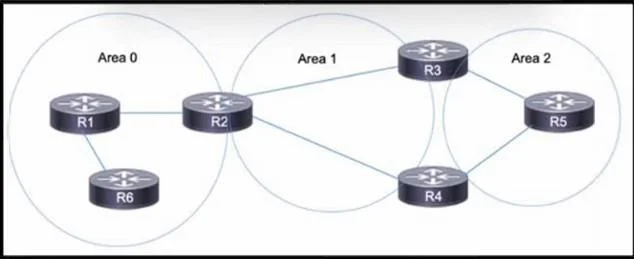
The correct answer is D. Extend area 0 to area 2 using a virtual link. OSPF requires every non-backbone area to connect to area 0 (the backbone). In the current design, area 2 peers only with area 1, not directly with area 0, so the LSA path from R6 (in area 0) to R5 (in area 2) isn’t complete. By configuring an OSPF virtual link between an ABR in…
Question
Refer to the exhibit. OSPF is configured in the network. The company operates several business units in a single building. To bring in a new business unit, which is located on a different floor from the others, a network engineer recently added area 2 to the network. To allow hosts connected to R5 to reach servers connected to R6, the engineer manipulated the OSPF path so that traffic from R6 traverses the link from R2 to R4 to reach R5. However, when the engineer ran a connectivity test between the host and server, it failed. Which action must the engineer take to resolve the issue?
Exhibit
Options
- AChange area 2 to a stub area.
- BConfigure a sham link between R6 and R2 to create a point-to-point link through the OSPF
- CRedistribute OSPF area 1 routes into area 2 on R3 and R4
- DExtend area 0 to area 2 using a virtual link.
How the community answered
(27 responses)- A15% (4)
- B7% (2)
- C4% (1)
- D74% (20)
Explanation
OSPF requires every non-backbone area to connect to area 0 (the backbone). In the current design, area 2 peers only with area 1, not directly with area 0, so the LSA path from R6 (in area 0) to R5 (in area 2) isn’t complete. By configuring an OSPF virtual link between an ABR in area 2 (for instance R4) and an ABR in area 0 (R2), you logically extend the backbone into area 2 and restore inter-area reachability.
Topics
Community Discussion
No community discussion yet for this question.