
300-510 · Question #170
Refer to the exhibit. A network engineer configured three new PE routers to expand the network. The new routers run the IS-IS routing protocol and reside in the data center in the same exchange as…
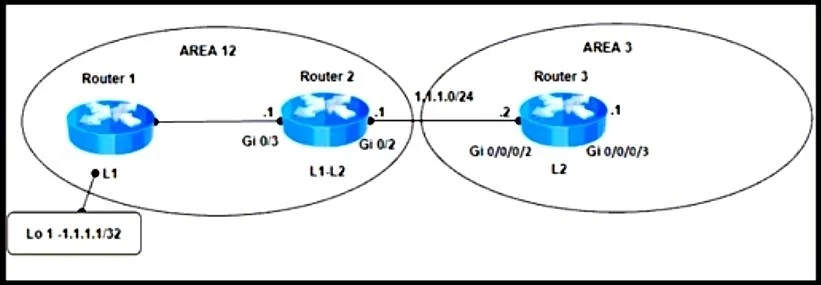
The correct answer is D. On Router 2, summarize internal routes between areas. In IS-IS, a Level 1/Level 2 (L1/L2) router sits at the boundary between an L1 area and the L2 backbone and is responsible for leaking or redistributing L1 prefix information into the L2 topology. Router 2 is the L1/L2 boundary router. When multiple new PE routers are added to…
Question
Refer to the exhibit. A network engineer configured three new PE routers to expand the network. The new routers run the IS-IS routing protocol and reside in the data center in the same exchange as the existing routers. However, the network is now experiencing suboptimal routing. The Layer 2 configuration and VLANs are configured correctly to provide segregation between networks, but the Level 1 routes are not being converted to Level 2 routes. Which action resolves the issue?
Exhibit
Options
- AOn Router 1, redistribute the routes into IGP.
- BOn Router 1, summarize internal routes between areas.
- COn Router 2, redistribute the routes into IGP.
- DOn Router 2, summarize internal routes between areas.
How the community answered
(52 responses)- A8% (4)
- B13% (7)
- C4% (2)
- D75% (39)
Explanation
In IS-IS, a Level 1/Level 2 (L1/L2) router sits at the boundary between an L1 area and the L2 backbone and is responsible for leaking or redistributing L1 prefix information into the L2 topology. Router 2 is the L1/L2 boundary router. When multiple new PE routers are added to the L1 area, the L1/L2 router should summarize their routes before advertising them into L2. Without proper summarization configured on Router 2, the L1 routes from the new PE routers are either not being advertised into L2 or are causing suboptimal routing because individual host/prefix routes are not propagated. Configuring route summarization on Router 2 aggregates internal L1 routes and correctly injects them into the L2 backbone, resolving the suboptimal routing condition.
Topics
Community Discussion
No community discussion yet for this question.