
300-430 · Question #314
Refer to the exhibit. A network engineer must deploy a new wireless solution to a branch location using a Cisco Catalyst 9800 Series Wireless Controller. To ensure that client traffic breaks out…
The correct answer is A. no central switching. On the Cisco Catalyst 9800, client traffic is centrally switched by default. The 'no central switching' command under the policy profile enables local switching so branch client traffic breaks out locally.
Question
Refer to the exhibit. A network engineer must deploy a new wireless solution to a branch location using a Cisco Catalyst 9800 Series Wireless Controller. To ensure that client traffic breaks out locally, a policy profile was created and configured. Which command must be added alter the policy name?
Exhibit
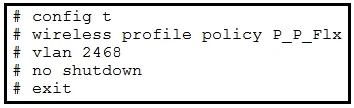
Options
- Ano central switching
- Bno central dhcp
- Cno local-site
- Dno central authentication
How the community answered
(26 responses)- A77% (20)
- B4% (1)
- C8% (2)
- D12% (3)
Why each option
On the Cisco Catalyst 9800, client traffic is centrally switched by default. The 'no central switching' command under the policy profile enables local switching so branch client traffic breaks out locally.
The 'no central switching' command in a policy profile disables central (CAPWAP tunnel) switching and configures the AP to forward client data traffic locally at the branch, which is the FlexConnect local switching behavior.
'no central dhcp' disables central DHCP processing and allows local DHCP at the branch, but does not control where client data traffic is switched.
'no local-site' is not a valid policy profile command for controlling the switching mode on the Catalyst 9800.
'no central authentication' shifts 802.1x authentication to the AP locally but does not affect data plane switching behavior.
Concept tested: Catalyst 9800 policy profile local switching configuration
Source: https://www.cisco.com/c/en/us/td/docs/wireless/controller/9800/config-guide/b_wl_16_10_cg/flexconnect.html
Topics
Community Discussion
No community discussion yet for this question.