
300-425 · Question #99
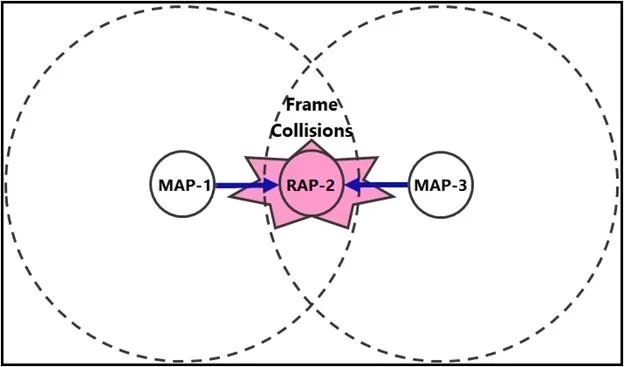
Refer to the exhibit. During a post Mesh deployment survey, an engineer notices that frame cessions occur when MAP-1 and MAP-3 talk to RAP-2. Which type of issue does the engineer need to address in…
The correct answer is C. hidden node. When two mesh nodes cannot hear each other but both transmit to the same parent node simultaneously, the resulting frame collisions at the parent are caused by the hidden node problem.
Question
Refer to the exhibit. During a post Mesh deployment survey, an engineer notices that frame cessions occur when MAP-1 and MAP-3 talk to RAP-2. Which type of issue does the engineer need to address in the design?
Exhibit
Options
- Aco-channel interference
- Bbackhaul latency
- Chidden node
- Dexposed node
How the community answered
(42 responses)- A21% (9)
- B10% (4)
- C64% (27)
- D5% (2)
Why each option
When two mesh nodes cannot hear each other but both transmit to the same parent node simultaneously, the resulting frame collisions at the parent are caused by the hidden node problem.
Co-channel interference involves multiple APs on the same channel degrading each other's performance across overlapping cells, not two nodes colliding at a single shared uplink receiver.
Backhaul latency refers to propagation or queuing delays in forwarding traffic through the mesh chain, not to frame collisions caused by simultaneous uncoordinated transmissions.
The hidden node problem occurs when MAP-1 and MAP-3 are out of range of each other but both are in range of RAP-2; neither MAP can detect the other's transmissions, so both send frames to RAP-2 simultaneously, causing collisions at the receiver. The standard mitigation is enabling RTS/CTS on the backhaul, which forces nodes to request permission before transmitting and prevents simultaneous collisions.
The exposed node problem occurs when a node unnecessarily defers transmission because it overhears a nearby node talking to a different receiver, which is the inverse scenario of what is described here.
Concept tested: Hidden node problem identification in wireless mesh deployments
Source: https://www.cisco.com/c/en/us/td/docs/wireless/controller/8-5/config-guide/b_cg85/mesh_network.html
Topics
Community Discussion
No community discussion yet for this question.