
300-425 · Question #167
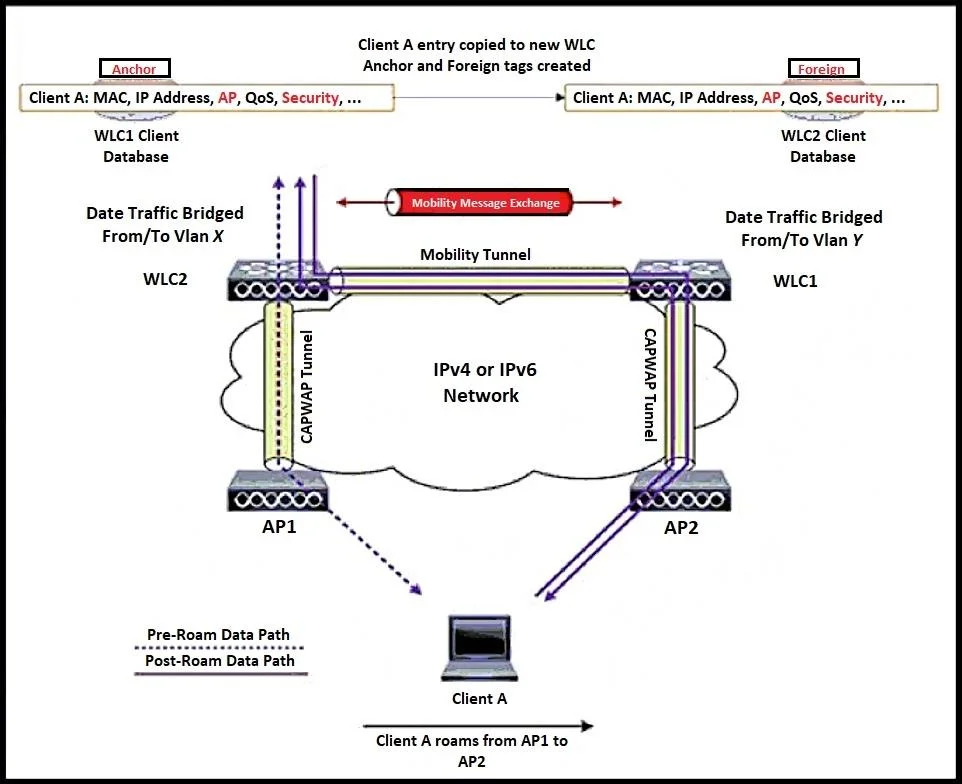
Refer to the exhibit. Client A is roaming from AP1 on WLC1 to AP2 on WLC2. The client roams between two APs registered to two different controllers. The WLAN on the two controllers is on a different…
The correct answer is B. The client database entry is different than that of Layer 2 roam. (Instead of moving, it copies the. When Client A roams from AP1 on WLC1 to AP2 on WLC2 across different subnets, this is considered a Layer 3 roam. Unlike Layer 2 roaming where the client's database entry moves with them, in Layer 3 roaming, the client's database entry is copied to the new controller (WLC2)…
Question
Refer to the exhibit. Client A is roaming from AP1 on WLC1 to AP2 on WLC2. The client roams between two APs registered to two different controllers. The WLAN on the two controllers is on a different subnet. Which scenario explains the client's roaming behavior?
Exhibit
Options
- AThe client database entry is different than that of Layer 2 roam. (Instead of copying, it moves the
- BThe client database entry is different than that of Layer 2 roam. (Instead of moving, it copies the
- CThe client database entry is different than that of Layer 2 roam because the client database is
- DThe client database remains in the mobility anchor controller and it is not copied or moved.
How the community answered
(62 responses)- A16% (10)
- B71% (44)
- C8% (5)
- D5% (3)
Explanation
When Client A roams from AP1 on WLC1 to AP2 on WLC2 across different subnets, this is considered a Layer 3 roam. Unlike Layer 2 roaming where the client's database entry moves with them, in Layer 3 roaming, the client's database entry is copied to the new controller (WLC2). This ensures continuity of service as Client A transitions between access points managed by different wireless LAN controllers.
Topics
Community Discussion
No community discussion yet for this question.