
300-425 · Question #26
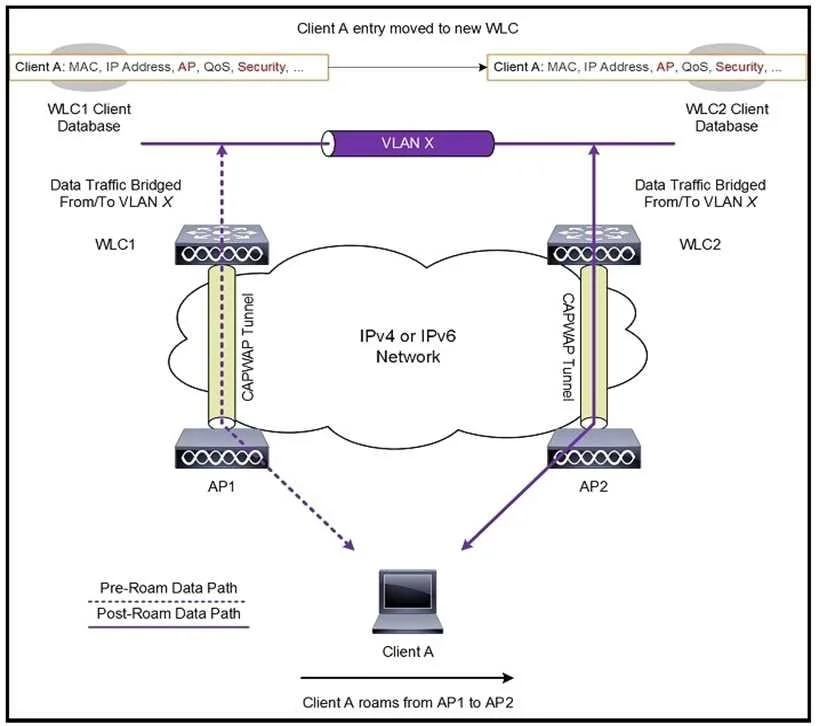
Refer to the exhibit. A client roams between two APs that are registered to two different controllers, where each controller has an interface in the client subnet. Both controllers are running…
The correct answer is A. Controllers exchange mobility control messages (over UDP port 16666) and the client database. When a client roams between APs on different AireOS controllers that share the same client subnet, the controllers perform a Layer 2 inter-controller roam by exchanging mobility messages and transferring the client database entry.
Question
Refer to the exhibit. A client roams between two APs that are registered to two different controllers, where each controller has an interface in the client subnet. Both controllers are running AireOS. Which scenario explains the client roaming behavior?
Exhibit
Options
- AControllers exchange mobility control messages (over UDP port 16666) and the client database
- BControllers do not exchange mobility control messages (over UDP port 16666) and the client
- CControllers exchange mobility control messages (over UDP port 16666) and a new client session
- DControllers exchange mobility control messages (over UDP port 16666) and the client database
How the community answered
(62 responses)- A74% (46)
- B15% (9)
- C3% (2)
- D8% (5)
Why each option
When a client roams between APs on different AireOS controllers that share the same client subnet, the controllers perform a Layer 2 inter-controller roam by exchanging mobility messages and transferring the client database entry.
Because both controllers have an interface in the client subnet, this is a Layer 2 inter-controller roam. The controllers exchange mobility control messages over UDP port 16666 to negotiate the roam, and the client database entry (including IP address, security context, and QoS settings) is transferred from the old controller to the new one, allowing the client to maintain its session seamlessly.
Mobility control message exchange over UDP 16666 always occurs between controllers in the same mobility group during inter-controller roaming; skipping this exchange would prevent coordinated roaming.
In a Layer 2 inter-controller roam on the same subnet, no new client session is started; the existing session and IP address are preserved by transferring the client database entry.
This option mirrors option A as presented; the key distinguishing behavior for this scenario is the database transfer (not a new session), which is correctly described by option A.
Concept tested: AireOS inter-controller Layer 2 client roaming
Source: https://www.cisco.com/c/en/us/support/docs/wireless/4400-series-wireless-lan-controllers/70240-wlc-roaming-faq.html
Topics
Community Discussion
No community discussion yet for this question.