
300-420 · Question #83
By default, if IS-IS is enabled on all routers, and this is an IPv6 network, what path is taken?
The correct answer is A. Path 1. By default, IS-IS in an IPv6 network will select the single path with the lowest cumulative metric to reach a destination.
Question
By default, if IS-IS is enabled on all routers, and this is an IPv6 network, what path is taken?
Exhibit
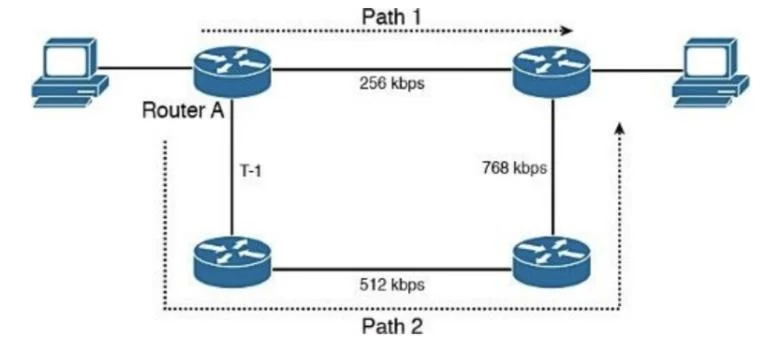
Options
- APath 1
- BPath 2
- CUnequal-cost load balancing with Path 1 and Path 2
- DEqual-cost load balancing with Path 1 and Path 2
How the community answered
(42 responses)- A88% (37)
- B2% (1)
- C2% (1)
- D7% (3)
Why each option
By default, IS-IS in an IPv6 network will select the single path with the lowest cumulative metric to reach a destination.
IS-IS, by default, determines the best path to a destination based on the shortest path first algorithm using link costs (metrics). In the absence of explicit equal-cost or unequal-cost load balancing configurations, IS-IS will always select and use the single path that has the lowest overall cumulative metric to the destination, which in this case is designated as Path 1.
Path 2 would only be chosen if it had a lower cumulative metric than Path 1, which contradicts the given correct answer that specifies Path 1.
Unequal-cost load balancing is not a default behavior in IS-IS; it requires specific configuration.
Equal-cost load balancing would only occur if Path 1 and Path 2 had identical cumulative metrics, and even then, the default behavior often involves load balancing, but the answer suggests a single best path.
Concept tested: IS-IS default path selection (lowest cost)
Source: https://www.cisco.com/c/en/us/td/docs/ios-xml/ios/iprout_isis/configuration/15-mt/irs-15-mt-book/irs-config-isis.html
Topics
Community Discussion
No community discussion yet for this question.