
300-420 · Question #423
Drag and Drop Question Drag and drop the Cisco Catalyst SD-WAN components from the left onto the functions they perform on the right. Answer:
The correct answer is vEdge; vManage; vSmart; vBond. This drag-and-drop question assesses knowledge of Cisco Catalyst SD-WAN architecture by matching core components to their specific functions.
Question
Exhibit
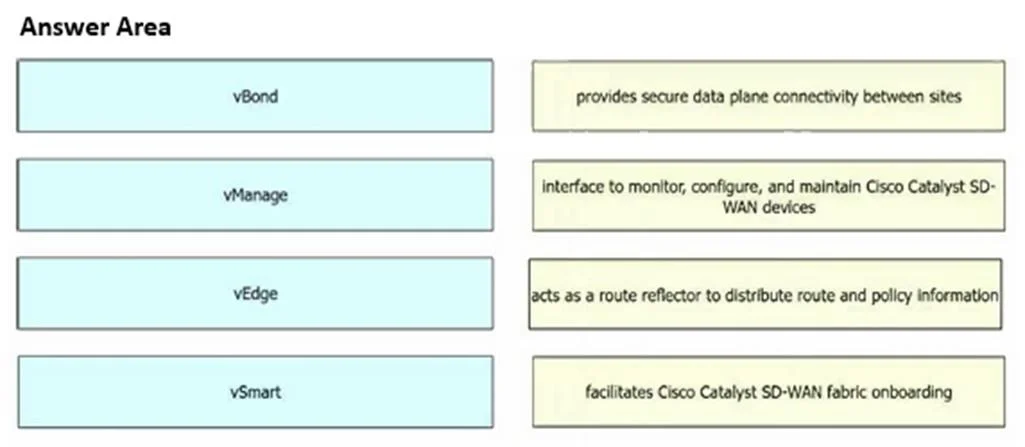
Answer Area
Drag items
Correct arrangement
- vEdge
- vManage
- vSmart
- vBond
Explanation
This drag-and-drop question assesses knowledge of Cisco Catalyst SD-WAN architecture by matching core components to their specific functions.
Approach. The correct interaction is to drag each Cisco Catalyst SD-WAN component from the left column to its corresponding function in the right column. Based on Cisco SD-WAN architecture:1. vBond should be dragged to 'facilitates Cisco Catalyst SD-WAN fabric onboarding'. The vBond orchestrator is part of the orchestration plane and handles initial authentication and onboarding of SD-WAN devices to the overlay network.2. vManage should be dragged to 'interface to monitor, configure, and maintain Cisco Catalyst SD-WAN devices'. The vManage NMS is the centralized network management system, providing a graphical user interface (GUI) for all configuration, monitoring, and troubleshooting tasks in the SD-WAN fabric. It's the management plane.3. vEdge should be dragged to 'provides secure data plane connectivity between sites'. vEdge devices (which include physical and virtual routers like the Catalyst 8000V or ISR4000 series) are the data plane components that sit at the network edge, encrypting and forwarding data traffic between different sites over secure IPsec tunnels.4. vSmart should be dragged to 'acts as a route reflector to distribute route and policy information'. The vSmart controller is the control plane component, establishing OMP (Overlay Management Protocol) peering with vEdge devices, distributing routing information, and enforcing centralized data policies across the SD-WAN overlay.
Common mistakes.
- common_mistake. Common mistakes include confusing the roles of the different SD-WAN planes. For example, incorrectly associating vBond (orchestration/onboarding) with data plane connectivity or management, or mistaking vSmart (control plane/routing/policies) for the management interface. Each component has a highly specialized role. Swapping vBond's role with vSmart's, or vManage's role with vEdge's, would demonstrate a fundamental misunderstanding of the SD-WAN architecture. For instance, assigning 'interface to monitor, configure, and maintain' to vSmart instead of vManage is incorrect because vSmart manages control plane policies, not the overall network configuration interface. Similarly, assigning 'provides secure data plane connectivity' to vBond instead of vEdge is wrong because vBond handles orchestration, not data forwarding.
Concept tested. Cisco Catalyst SD-WAN architecture, understanding the distinct roles and functions of the core components (vBond orchestrator, vManage NMS, vEdge routers, and vSmart controller), and their respective planes (orchestration, management, data, and control).
Topics
Community Discussion
No community discussion yet for this question.