
300-420 · Question #394
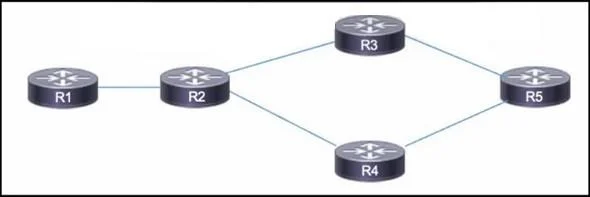
Refer to the exhibit. A large company is planning to deploy OSPF in this environment. - All routers will be in Area 0. - R1 will support an isolated environment that does not require routing outside…
The correct answer is B. Deploy R1 only as a stub router. Configuring R1 as a stub router reduces its OSPF memory and CPU requirements by preventing it from receiving unnecessary external route advertisements. R1 will receive a default route from its neighbor (to R5 for internet access) while not maintaining a full OSPF database…
Question
Refer to the exhibit. A large company is planning to deploy OSPF in this environment.
- All routers will be in Area 0.
- R1 will support an isolated environment that does not require routing
outside of the networks that it runs locally, but it must be able to access the internet.
- R5 will serve as the access point to the internet.
While planning for the new deployment, the engineering team noticed that router R1 has been having memory issues. Which action with an updated OSPF design reduces the resource load on R1?
Exhibit
Options
- ADeploy R1 and R5 as stub routers.
- BDeploy R1 only as a stub router.
- CImplement a virtual link from R1 to R5.
- DImplement a sham link from R2 to R5.
How the community answered
(50 responses)- A18% (9)
- B72% (36)
- C6% (3)
- D4% (2)
Explanation
Configuring R1 as a stub router reduces its OSPF memory and CPU requirements by preventing it from receiving unnecessary external route advertisements. R1 will receive a default route from its neighbor (to R5 for internet access) while not maintaining a full OSPF database, directly addressing its resource limitations.
Topics
Community Discussion
No community discussion yet for this question.