
300-420 · Question #356
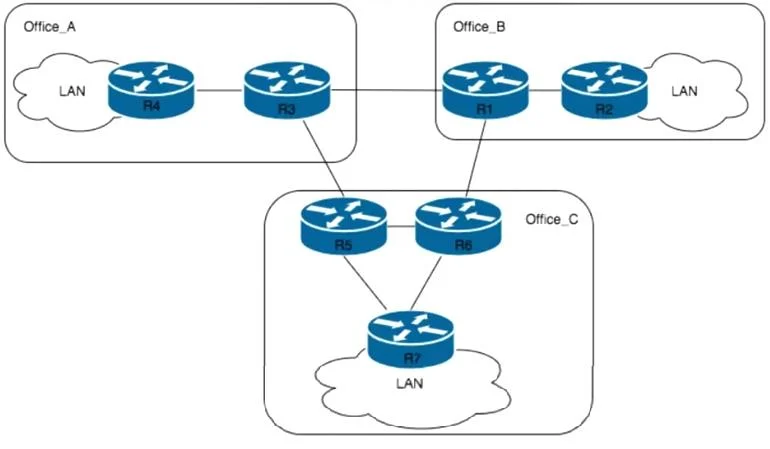
Refer to the exhibit. A company has some offices that are connected via dark fiber in New York. A network architect must optimize the network design based on the EIGRP routing protocol. The network…
The correct answer is A. Implement network summarization on edge routers. To minimize EIGRP routing convergence time and reduce the query range in a hierarchical network with multiple offices, implementing network summarization on edge routers is crucial.
Question
Refer to the exhibit. A company has some offices that are connected via dark fiber in New York. A network architect must optimize the network design based on the EIGRP routing protocol. The network has hierarchical addressing between 10 and 12 routers in each office. Routing convergence time must be at the minimum. What must the network architect do to reduce the query range?
Exhibit
Options
- AImplement network summarization on edge routers.
- BConfigure route filtering on non-edge routers.
- CConfigure stub areas on non-edge routers.
- DUse different EIGRP processes on edge routers.
How the community answered
(28 responses)- A71% (20)
- B11% (3)
- C4% (1)
- D14% (4)
Why each option
To minimize EIGRP routing convergence time and reduce the query range in a hierarchical network with multiple offices, implementing network summarization on edge routers is crucial.
EIGRP network summarization on edge routers creates explicit boundaries for DUAL (Diffusing Update Algorithm) queries. When a route behind a summary becomes unreachable, queries for that specific route are contained within the summarized area, as the router performing the summarization responds authoritatively. This significantly reduces the propagation of queries across the network, leading to faster convergence and less CPU overhead on other routers.
Route filtering controls which routes are advertised or accepted, but it does not directly prevent EIGRP queries from being sent out or define query boundaries.
EIGRP uses 'stub routers' to contain queries within a network segment, but the question specifies 'stub areas' (an OSPF concept) and suggests configuring 'non-edge routers,' which is generally not the best application for EIGRP stub functionality.
Using different EIGRP processes creates separate routing domains that require redistribution, adding complexity and not directly addressing the reduction of query range within a single logical EIGRP domain.
Concept tested: EIGRP summarization to limit queries
Source: https://www.cisco.com/c/en/us/td/docs/ios-xml/ios/iproute_eigrp/configuration/xe-3s/ire-xe-3s-book/ire-cfg-eigrp.html
Topics
Community Discussion
No community discussion yet for this question.