
300-420 · Question #331
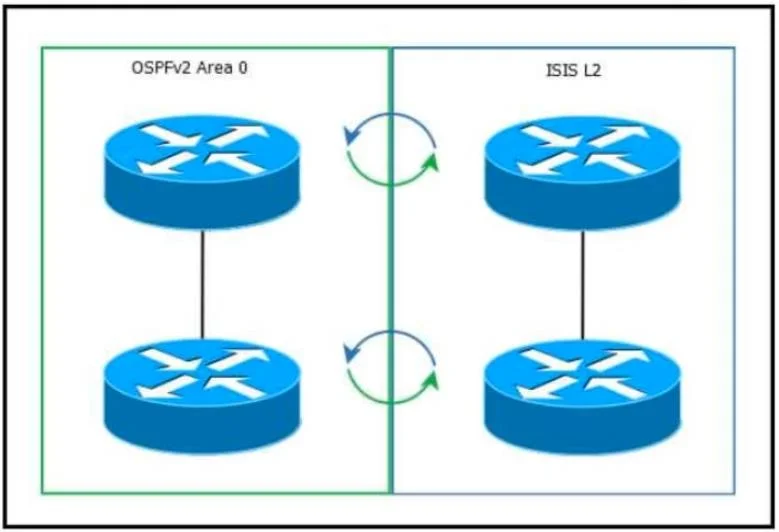
Refer to the exhibit. An architect is designing a network that requires route redistribution. The design must prevent route feedback and the creation of routing loops. The OSPF domain is using…
The correct answer is C. Use route tagging with a route map. To prevent route feedback and routing loops during mutual redistribution between OSPF and IS-IS with different metric types, route tagging with a route map is the most effective solution.
Question
Refer to the exhibit. An architect is designing a network that requires route redistribution. The design must prevent route feedback and the creation of routing loops. The OSPF domain is using default metrics, and the IS-IS domain is using narrow metrics. Which solution must the architect select?
Exhibit
Options
- AChange the IS-IS administrative distance to 105
- BUse route filtering with an ACL or prefix list
- CUse route tagging with a route map
- DChange the OSPF area to a nonbackbone stub area
How the community answered
(31 responses)- A10% (3)
- B3% (1)
- C84% (26)
- D3% (1)
Why each option
To prevent route feedback and routing loops during mutual redistribution between OSPF and IS-IS with different metric types, route tagging with a route map is the most effective solution.
Changing the administrative distance (AD) only influences the best path selection when a router has multiple paths to the same destination learned via different routing protocols; it does not prevent routes from being redistributed back into their original domain or address the core problem of route feedback and loops.
Route filtering with an ACL or prefix list can control which routes are redistributed, but it does not inherently prevent route feedback in complex redistribution scenarios unless meticulously crafted to match specific route attributes, which can be less robust and scalable than route tagging for loop prevention.
Route tagging with a route map allows an administrator to mark routes as they are redistributed from one routing protocol into another. When routes are redistributed from OSPF to IS-IS, they can be tagged, and then a route map can be configured on the IS-IS to OSPF redistribution point to prevent any routes with that specific tag from being redistributed back into OSPF, effectively preventing routing loops and feedback.
Changing an OSPF area to a nonbackbone stub area affects how external routes are learned within that specific OSPF area (e.g., preventing external LSAs or only allowing a default route), but it does not directly solve the problem of route feedback and loops during mutual redistribution between OSPF and IS-IS.
Concept tested: Route redistribution loop prevention, route tagging
Source: https://www.cisco.com/c/en/us/td/docs/ios-xml/ios/iproute_pi/configuration/15-s/ipi-15-s-book/ipi-route-redist-loop-prev.html
Topics
Community Discussion
No community discussion yet for this question.