
300-420 · Question #307
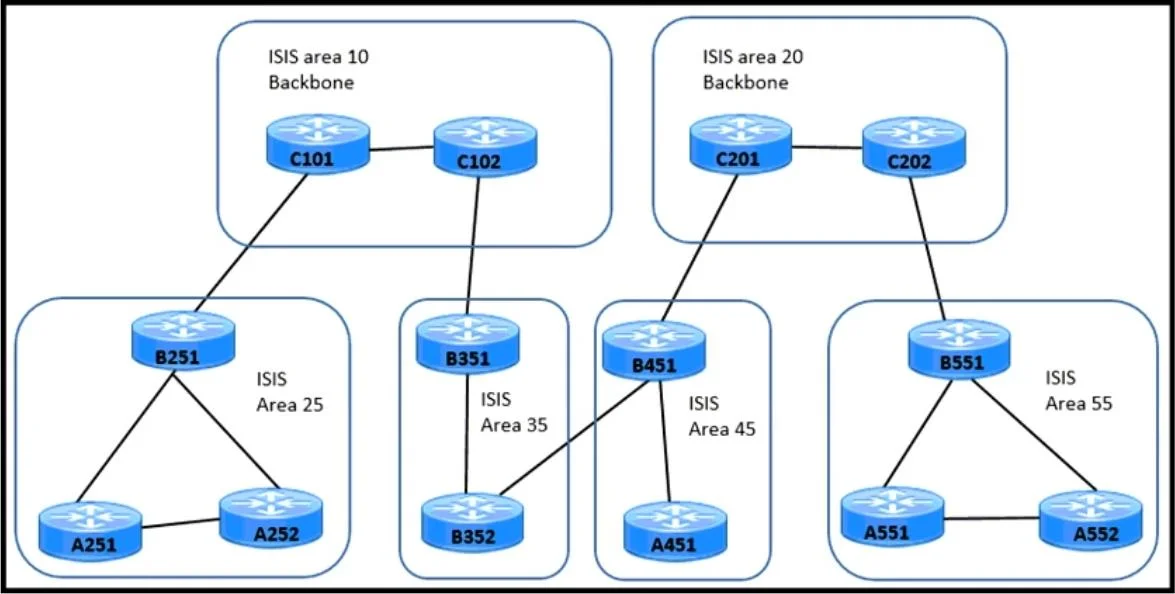
Refer to the exhibit. An engineer is designing a hierarchical ISIS solution for an enterprise customer with these requirements: - Users in areas 25 and 55 send and receive traffic from both backbone…
The correct answer is D. A series routers Level 1, B series routers Level 1/2, and C series routers Level 2. The engineer should select a design where A series routers are Level 1, B series routers are Level 1/2, and C series routers are Level 2 to provide area isolation and a robust backbone.
Question
Refer to the exhibit. An engineer is designing a hierarchical ISIS solution for an enterprise customer with these requirements:
- Users in areas 25 and 55 send and receive traffic from both backbone
areas.
- Link flaps in areas 35 and 45 must not impact other areas.
- Routers will double within the next 12 months in areas 35 and 45.
Which design must the engineer select?
Exhibit
Options
- AA series routers Level 2, B series routers Level 2, and C series routers Level 1
- BA series routers Level 1/2, B series routers Level 1/2, and C series routers Level 1/2
- CA series routers Level 1/2, B series routers Level 2, and C series routers Level 2
- DA series routers Level 1, B series routers Level 1/2, and C series routers Level 2
How the community answered
(51 responses)- A12% (6)
- B6% (3)
- C22% (11)
- D61% (31)
Why each option
The engineer should select a design where A series routers are Level 1, B series routers are Level 1/2, and C series routers are Level 2 to provide area isolation and a robust backbone.
This configuration would place Level 2 routers in areas meant for isolation (35, 45) and Level 1 routers (C series) in what should be a backbone area (55), preventing proper inter-area routing and isolation.
An all Level 1/2 design would propagate link flaps more broadly, failing to meet the requirement for isolating instability in areas 35 and 45 by not creating distinct Level 1 boundaries.
Configuring B and C series as Level 2 means areas 35 and 45 would be part of the Level 2 backbone, which would not isolate link flaps and growth from other areas as required.
Configuring A series routers as Level 1 creates Level 1 areas (like 25), B series as Level 1/2 enables them to connect Level 1 areas (35, 45) to the Level 2 backbone and isolate link flaps, and C series as Level 2 forms the reliable backbone (55) to carry inter-area traffic.
Concept tested: Hierarchical IS-IS design levels
Source: https://www.cisco.com/c/en/us/td/docs/ios-xml/ios/iproute_isis/configuration/15-s/irs-15-s-book/irs-config-isis.html
Topics
Community Discussion
No community discussion yet for this question.