
300-420 · Question #306
Refer to the exhibit. A network engineer must design a highly available OSPF solution based on these requirements: - Traffic disruptions caused by link or node failures in Area-1 must be resolved in…
The correct answer is C. Utilize BFD and tune the BFD timers to 100 ms. To achieve millisecond-level fault detection and rapid traffic redirection without waiting for OSPF dead intervals, Bidirectional Forwarding Detection (BFD) must be utilized and tuned to aggressive timers.
Question
Refer to the exhibit. A network engineer must design a highly available OSPF solution based on these requirements:
- Traffic disruptions caused by link or node failures in Area-1 must be
resolved in milliseconds.
- In the event of a failure, traffic must switch to another path
without waiting for the OSPF dead interval. Which fault detection solution must the engineer choose?
Exhibit
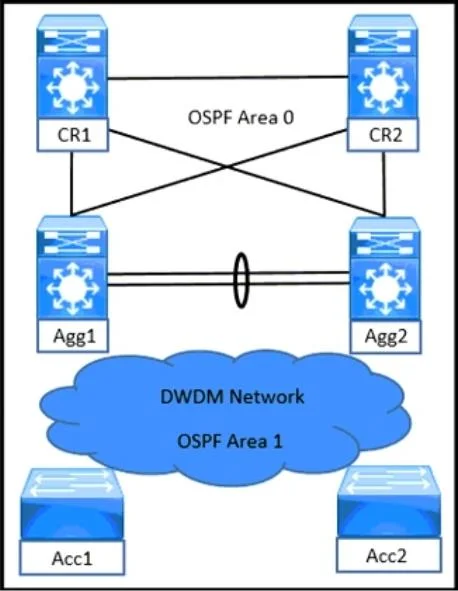
Options
- ADecrease SPF timers to 100 ms.
- BTune the SPF delay and the OSPF LSA interval timers to 100 ms.
- CUtilize BFD and tune the BFD timers to 100 ms.
- DEnable IP SLA tracking for each OSPF peer.
How the community answered
(38 responses)- A8% (3)
- B5% (2)
- C71% (27)
- D16% (6)
Why each option
To achieve millisecond-level fault detection and rapid traffic redirection without waiting for OSPF dead intervals, Bidirectional Forwarding Detection (BFD) must be utilized and tuned to aggressive timers.
Decreasing SPF timers influences how quickly OSPF recomputes the shortest path after a topology change is *detected*, but it does not accelerate the initial detection of a link or node failure itself.
Tuning SPF delay and OSPF LSA interval timers affects routing convergence after a failure is detected or how frequently updates are sent, but it does not provide millisecond-level fault detection for direct link failures.
BFD is a lightweight protocol designed for rapid fault detection on forwarding paths, capable of detecting failures in milliseconds, which allows OSPF to react much faster than its default hello/dead timers and immediately switch traffic to an alternate path.
IP SLA tracking can monitor network performance and detect failures, but it typically has higher detection times than BFD and is not designed for the millisecond fault detection required for immediate path switching.
Concept tested: OSPF fast convergence with BFD
Source: https://www.cisco.com/c/en/us/td/docs/ios-xml/ios/iproute_ospf/configuration/15-mt/iro-15-mt-book/iro-bfd-support-ospfv3.html
Topics
Community Discussion
No community discussion yet for this question.