
300-420 · Question #238
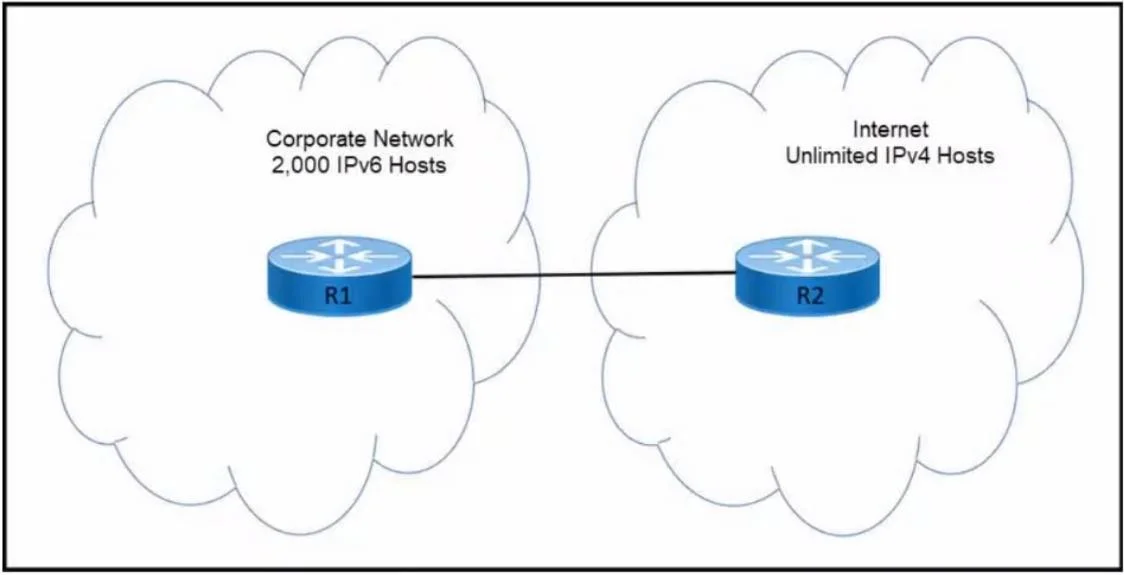
Refer to the exhibit. An engineer must design an address translation solution to provide internet connectivity for the corporate network. The design is restricted to the 172.16.168.0/22 subnet…
The correct answer is D. stateful NAT64. To provide internet connectivity for an IPv6 corporate network by translating to IPv4 internet resources, stateful NAT64 is the correct address translation solution.
Question
Refer to the exhibit. An engineer must design an address translation solution to provide internet connectivity for the corporate network. The design is restricted to the 172.16.168.0/22 subnet. Which solution must the engineer choose?
Exhibit
Options
- Astateful NAT66
- Bstateless NAT64
- Cstateless NAT66
- Dstateful NAT64
How the community answered
(42 responses)- A2% (1)
- B14% (6)
- C7% (3)
- D76% (32)
Why each option
To provide internet connectivity for an IPv6 corporate network by translating to IPv4 internet resources, stateful NAT64 is the correct address translation solution.
Stateful NAT66 is used for IPv6-to-IPv6 translation, typically for address hiding or renumbering, not for connecting an IPv6 network to the IPv4 internet.
Stateless NAT64 does not maintain session state, making it generally unsuitable for robust outbound internet connectivity where many internal hosts share a limited pool of external IPv4 addresses.
Stateless NAT66 is for IPv6-to-IPv6 translation and does not provide connectivity to the IPv4 internet.
NAT64 is the mechanism that allows IPv6-only clients to communicate with IPv4-only servers, which is essential for an IPv6 corporate network to access the current IPv4-dominated internet. Stateful NAT64 is the standard implementation for outbound internet connectivity as it maintains session state for connections, allowing return traffic to be correctly mapped to internal IPv6 hosts.
Concept tested: IPv6 to IPv4 translation (NAT64) for internet access
Source: https://datatracker.ietf.org/doc/html/rfc6146
Topics
Community Discussion
No community discussion yet for this question.