
300-420 · Question #181
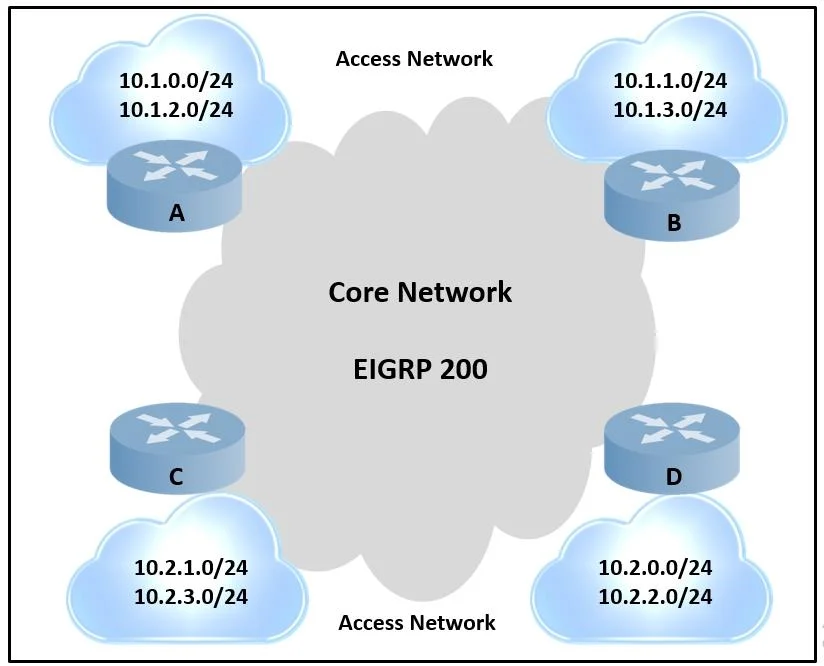
Refer to the exhibit. An engineer is designing a routing solution for a customer. The design must ensure that a failure of network 10.1.0.0/24, 10.1.2.0/24, 10.2.1.0/24, or 10.2.3.0/24 does not…
The correct answer is C. Enable FRR for the connected networks of routers A and C. This question asks for a routing solution that provides both fast convergence during link failures and prevents local network failures from impacting the core routing table.
Question
Refer to the exhibit. An engineer is designing a routing solution for a customer. The design must ensure that a failure of network 10.1.0.0/24, 10.1.2.0/24, 10.2.1.0/24, or 10.2.3.0/24 does not impact the core. It also requires fast convergence time during any link failover in the core or access networks. Which solution must the engineer select?
Exhibit
Options
- AAdd aggregation layer between core and access networks.
- BEnable graceful restart on routers A and C.
- CEnable FRR for the connected networks of routers A and C.
- DEnable summarization on routers A and C.
How the community answered
(22 responses)- A23% (5)
- B9% (2)
- C64% (14)
- D5% (1)
Why each option
This question asks for a routing solution that provides both fast convergence during link failures and prevents local network failures from impacting the core routing table.
Adding an aggregation layer is a design best practice but does not inherently provide fast convergence or prevent specific network failures from impacting the core without additional routing features.
Graceful Restart helps routing protocols maintain peering relationships and continue forwarding during control plane restarts, but it does not primarily address containing network failures or providing immediate rerouting for link failures.
Enabling FRR (Fast Reroute) on routers A and C for their connected networks ensures sub-50ms convergence by pre-calculating and installing backup paths, directly addressing the need for fast convergence. This local repair also prevents the immediate propagation of failure events to the core, thus minimizing impact on the core network's routing stability.
Enabling summarization on routers A and C reduces the number of routes advertised to the core, thereby preventing specific route withdrawals from causing churn in the core routing table, but it does not provide fast convergence for traffic to the failed segment itself.
Concept tested: Fast Reroute (FRR) for network resilience
Source: https://www.cisco.com/c/en/us/products/collateral/ios-nx-os-software/ip-fast-reroute-frr/data_sheet_c78-577517.html
Topics
Community Discussion
No community discussion yet for this question.