
300-420 · Question #180
Refer to the exhibit. An architect must design an IGP solution for an enterprise customer. The design must support: - Physical link flaps should have minimal impact. - Access routers should converge…
The correct answer is C. Reduce SPF and PRC intervals to improve convergence time. E. Configure access routers to establish a Level 1 adjacency and aggregate routers to establish a. Answer C should be responsible for timer optimization. Answer E should be the proper design in an "IS-IS Hybrid topology design". (L1/L2 routers maintain a separate lin-state database for L1 routes and L2 routes > This increases their CPU > So Access routes should never be both…
Question
Refer to the exhibit. An architect must design an IGP solution for an enterprise customer. The design must support:
- Physical link flaps should have minimal impact.
- Access routers should converge quickly after a link failure.
Which two ISIS solutions should the architect include in the design? (Choose two.)
Exhibit
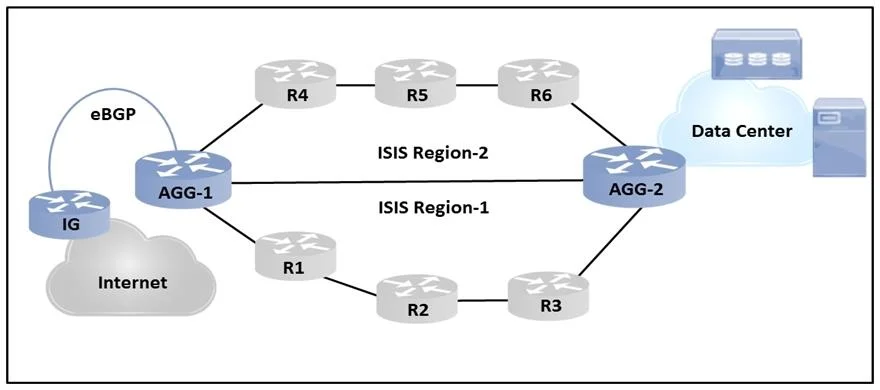
Options
- AUse BGP to IS-IS redistribution to advertise all Internet routes in the Level 1 area.
- BAdvertise the IS-IS interface and loopback IP address toward the Internet and data center.
- CReduce SPF and PRC intervals to improve convergence time.
- DConfigure all access and aggregate routers to establish Level 1 / Level 2 adjacencies across the
- EConfigure access routers to establish a Level 1 adjacency and aggregate routers to establish a
How the community answered
(39 responses)- A3% (1)
- B10% (4)
- C82% (32)
- D5% (2)
Explanation
Answer C should be responsible for timer optimization. Answer E should be the proper design in an "IS-IS Hybrid topology design". (L1/L2 routers maintain a separate lin-state database for L1 routes and L2 routes > This increases their CPU > So Access routes should never be both L1/L2 devices, only pure L1
Topics
Community Discussion
No community discussion yet for this question.