
300-420 · Question #172
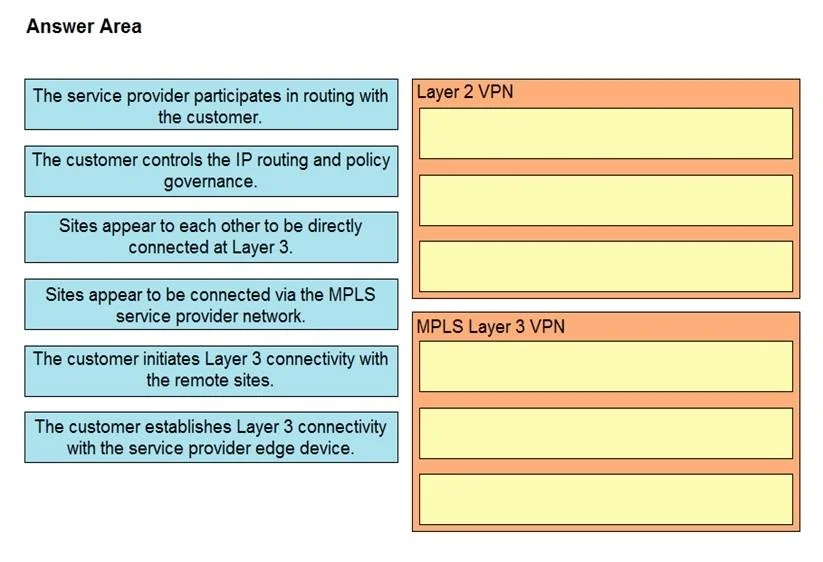
Drag and Drop Question Drag and drop the descriptions from the left onto the corresponding VPN types on the rights. Answer:
The correct answer is The customer controls the IP routing and policy governance.; Sites appear to each other to be directly connected at Layer 3.; The customer initiates Layer 3 connectivity with the remote sites.; The service provider participates in routing with the customer.; Sites appear to be connected via the MPLS service provider network.; The customer establishes Layer 3 connectivity with the service provider edge device. This question tests the understanding of the fundamental differences and characteristics between Layer 2 VPNs and MPLS Layer 3 VPNs, focusing on customer control, routing responsibility, and how sites perceive connectivity.
Question
Drag and Drop Question Drag and drop the descriptions from the left onto the corresponding VPN types on the rights. Answer:
Exhibit
Answer Area
Drag items
Correct arrangement
- The customer controls the IP routing and policy governance.
- Sites appear to each other to be directly connected at Layer 3.
- The customer initiates Layer 3 connectivity with the remote sites.
- The service provider participates in routing with the customer.
- Sites appear to be connected via the MPLS service provider network.
- The customer establishes Layer 3 connectivity with the service provider edge device.
Explanation
This question tests the understanding of the fundamental differences and characteristics between Layer 2 VPNs and MPLS Layer 3 VPNs, focusing on customer control, routing responsibility, and how sites perceive connectivity.
Approach. The correct interaction is to drag the descriptions from the left column into the appropriate slots under either 'Layer 2 VPN' or 'MPLS Layer 3 VPN' on the right, matching the solved state shown in the second image.
For Layer 2 VPN:
- 'The customer controls the IP routing and policy governance.': In a Layer 2 VPN, the service provider offers a transparent Layer 2 link (like an extended LAN segment). All IP routing decisions and policies are entirely managed by the customer over this link.
- 'Sites appear to each other to be directly connected at Layer 3.': Because the SP provides a Layer 2 transport, customer devices at different sites can form Layer 3 adjacencies (e.g., OSPF neighbors, BGP peers) as if they were on the same physical segment.
- 'The customer initiates Layer 3 connectivity with the remote sites.': Since the Layer 2 VPN acts as a transparent medium, the customer's routers directly establish routing protocol peering and Layer 3 communication with their other routers at remote sites.
For MPLS Layer 3 VPN:
- 'The service provider participates in routing with the customer.': In an MPLS Layer 3 VPN, the customer's router (CE - Customer Edge) peers with the service provider's router (PE - Provider Edge) using a Layer 3 routing protocol (e.g., BGP, OSPF). The SP manages the routing between customer sites within its network.
- 'Sites appear to be connected via the MPLS service provider network.': From the customer's perspective, traffic between sites traverses the service provider's routed MPLS network. The SP acts as a Layer 3 hop between the customer's sites.
- 'The customer establishes Layer 3 connectivity with the service provider edge device.': The core characteristic of an MPLS Layer 3 VPN is that the customer's CE device forms a Layer 3 routing adjacency with the SP's PE device, handing off routing responsibilities to the SP for inter-site connectivity.
Common mistakes.
- common_mistake. A common mistake is confusing the level of control and responsibility for IP routing between the customer and the service provider. For instance, incorrectly assigning 'The customer controls the IP routing and policy governance' to MPLS Layer 3 VPN is wrong because in L3VPNs, the SP takes an active role in routing. Conversely, assigning 'The service provider participates in routing with the customer' to Layer 2 VPN is incorrect because L2VPNs are designed for transparent Layer 2 transport, with the customer maintaining full L3 control. Another error would be to misunderstand how sites perceive connectivity-in L2VPNs, sites appear directly connected at L3, while in L3VPNs, they are clearly connected via the SP's L3 network. Misplacing any of the 'customer initiates connectivity' statements also indicates a lack of understanding of the peering relationships at Layer 3 in each VPN type.
Concept tested. Virtual Private Networks (VPNs) - specifically the architectural and operational differences between Layer 2 VPNs (e.g., VPLS, VPWS over MPLS) and MPLS Layer 3 VPNs (e.g., BGP/MPLS IP VPNs), including responsibilities for routing, control plane interactions, and perceived network topology from the customer's perspective.
Topics
Community Discussion
No community discussion yet for this question.