
300-415 · Question #318
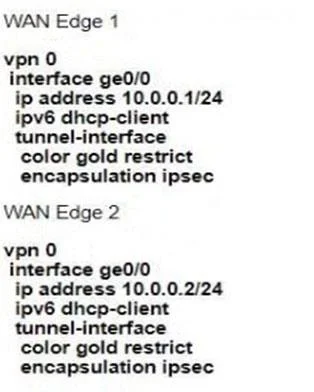
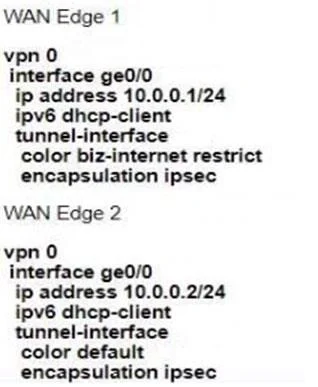
Refer to the exhibit. The network team must configure application-aware routing for the Service VPN 50.0.0.0/16. The SLA must prefer MPLS for video traffic, but the remaining traffic must use a…
The correct answer is C. Application, SLA, VPN, Prefix. To configure application-aware routing, the network team must define SLA classes to specify path preferences, the VPN to which the policy applies, and the data prefixes to identify the traffic scope.
Question
Exhibits
Options
- AColor, SLA Class, Site, VPN
- BData Prefix, Site, VPN, TLOC
- CApplication, SLA, VPN, Prefix
- DSLA Class, Site, VPN, Prefix
How the community answered
(33 responses)- A3% (1)
- B9% (3)
- C73% (24)
- D15% (5)
Why each option
To configure application-aware routing, the network team must define SLA classes to specify path preferences, the VPN to which the policy applies, and the data prefixes to identify the traffic scope.
"Color" and "Site" are attributes of the transport or device, not direct components defined as prerequisites for the application-aware policy itself in this context.
"TLOC" is a transport location identifier, which is part of the underlying network but not a configuration element defined before the application-aware policy creation itself.
Application-aware routing policies require the definition of SLA classes to specify performance requirements, the VPN context for traffic, and relevant prefixes to match the desired traffic, in addition to identifying the applications. These components are prerequisites for building an effective application-aware routing policy.
"Site" is a device-level attribute and not a direct component that needs to be defined as part of the application-aware routing policy configuration.
Concept tested: SD-WAN Application-Aware Routing prerequisites
Source: https://www.cisco.com/c/en/us/td/docs/routers/sdwan/configuration/routing/ios-xe-17/routing-book-xe/m-app-aware-routing.html
Topics
Community Discussion
No community discussion yet for this question.