
300-415 · Question #114
Refer to the exhibit. An administrator is configuring a policy in addition to an existing hub-and-spoke policy for two sites that should directly communicate with each other. How is this policy…
The correct answer is D. custom control (route and TLOC). To enable direct communication between two specific sites within an existing hub-and-spoke topology, an administrator must configure a custom centralized control policy that manipulates routes and TLOCs.
Question
Exhibits
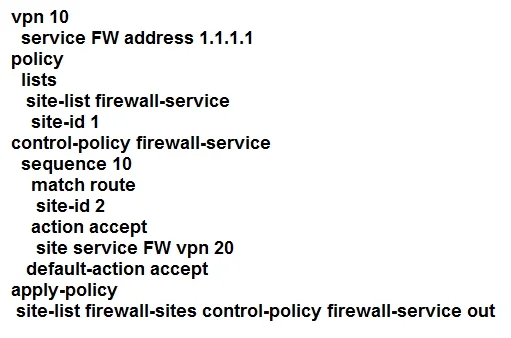
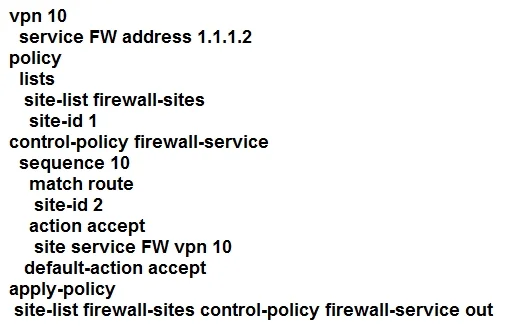
Options
- Ahub-and-spoke
- Bmesh
- Cimport existing topology
- Dcustom control (route and TLOC)
How the community answered
(31 responses)- A3% (1)
- B10% (3)
- C3% (1)
- D84% (26)
Why each option
To enable direct communication between two specific sites within an existing hub-and-spoke topology, an administrator must configure a custom centralized control policy that manipulates routes and TLOCs.
Configuring another 'hub-and-spoke' policy would maintain or reinforce the existing indirect communication model through the hub.
A 'mesh' policy would enable direct communication between all spokes, which is more extensive than the requirement for only two specific sites.
'Import existing topology' is a functional step in vManage for policy creation but not a policy type that enables specific direct spoke-to-spoke communication paths.
A custom centralized control policy, specifically one that allows granular modification of route advertisements and TLOC (Transport Location) reachability, is required to achieve direct spoke-to-spoke communication. This policy overrides the default hub-and-spoke behavior for designated sites, enabling them to establish direct data plane tunnels.
Concept tested: SD-WAN centralized control policies for direct spoke-to-spoke
Source: https://www.cisco.com/c/en/us/td/docs/routers/sdwan/configuration/sdwan-xe-gs-book/m-centralized-control-policy.html
Topics
Community Discussion
No community discussion yet for this question.