
300-410 · Question #12
Which attribute eliminates LFAs that belong to protected paths in situations where links in a network are connected through a common fiber?
The correct answer is B. Shared risk link group-disjoint. Shared Risk Link Group-disjoint is the attribute that eliminates Loop-Free Alternates (LFAs) if they traverse paths that share a common underlying resource with the protected primary path, ensuring true path diversity.
Question
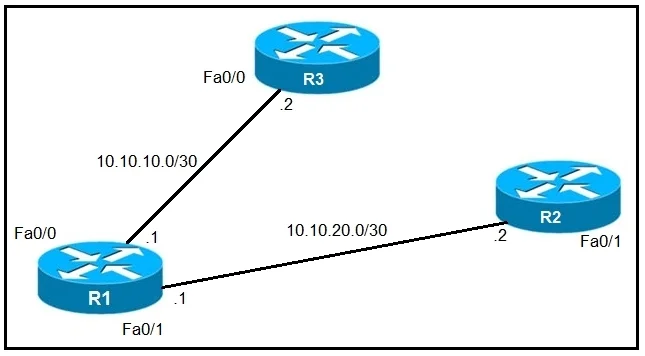
Exhibit
Options
- AInterface-disjoint
- BShared risk link group-disjoint
- CLinecard-disjoint
- DLowest-repair-path-metric
How the community answered
(34 responses)- A15% (5)
- B76% (26)
- C6% (2)
- D3% (1)
Why each option
Shared Risk Link Group-disjoint is the attribute that eliminates Loop-Free Alternates (LFAs) if they traverse paths that share a common underlying resource with the protected primary path, ensuring true path diversity.
Interface-disjoint means the backup path doesn't use the same outgoing interface, but it doesn't account for shared physical infrastructure beyond the interface.
A Shared Risk Link Group (SRLG) is a set of links that share a common physical resource, such as a fiber conduit. To ensure true resiliency, an SRLG-disjoint LFA is required, meaning the backup path does not use any link that belongs to the same SRLG as the primary path, thus avoiding a single point of failure.
Linecard-disjoint means the backup path doesn't use the same line card, which addresses hardware redundancy but not shared fiber infrastructure.
Lowest-repair-path-metric relates to the cost of the repair path, not an attribute for ensuring disjointness based on shared physical risks like common fiber.
Concept tested: MPLS/IP Fast Reroute (FRR) and Shared Risk Link Groups (SRLGs)
Source: https://www.cisco.com/c/en/us/td/docs/ios-xml/ios/iproute_frr/configuration/15-mt/frr-15-mt-book/frr-ipfrr.html
Topics
Community Discussion
No community discussion yet for this question.