
300-370 · Question #80
You have designed your wireless network for data coverage. However, as 5 GHz device a client's increase over legacy 2.4 GHz devices, you observe roaming issues and instability of wireless…
The correct answer is D. 5 GHz cell size is smaller than 2.4 GHz cell size, which results in inadequate overlap for 5 GHz clients. Roaming instability and wireless communication issues for 5 GHz clients, especially when upgrading from legacy 2.4 GHz devices, typically stem from the inherent differences in radio signal propagation between the two bands. The shorter range and greater attenuation of 5 GHz…
Question
You have designed your wireless network for data coverage. However, as 5 GHz device a client's increase over legacy 2.4 GHz devices, you observe roaming issues and instability of wireless communication for the newest devices. Which element will cause this issue?
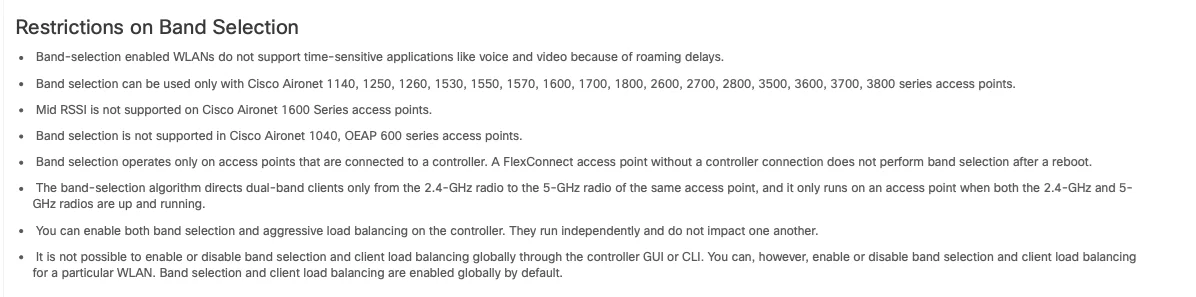
Exhibit
Options
- AYou have designed for data coverage, but you need a voice design to accommodate 5 GHz devices.
- BBand Select is ON and steers clients to connect to 2.4 GHZ over 5 GHz.
- CRRM is ON and favors 2.4 GHz legacy devices.
- D5 GHz cell size is smaller than 2.4 GHz cell size, which results in inadequate overlap for 5 GHz clients.
How the community answered
(31 responses)- A16% (5)
- B6% (2)
- C3% (1)
- D74% (23)
Why each option
Roaming instability and wireless communication issues for 5 GHz clients, especially when upgrading from legacy 2.4 GHz devices, typically stem from the inherent differences in radio signal propagation between the two bands. The shorter range and greater attenuation of 5 GHz signals result in smaller cell sizes and inadequate coverage overlap.
While a voice design has more stringent requirements, the fundamental physical issue causing roaming problems for 5 GHz devices in a data design is more specific than simply needing a different design type, pointing instead to coverage planning.
Band Select (or Band Steering) typically attempts to encourage dual-band clients to connect to the 5 GHz band over the 2.4 GHz band, not the other way around, to utilize the less congested 5 GHz spectrum.
Radio Resource Management (RRM) optimizes channel and power settings for both bands to improve overall network performance and capacity, not to inherently favor 2.4 GHz legacy devices to the detriment of 5 GHz client roaming.
5 GHz radio waves experience greater attenuation and thus have a shorter effective range compared to 2.4 GHz radio waves at the same transmit power. If a wireless network is designed primarily for 2.4 GHz coverage, the resulting 5 GHz cell sizes will be significantly smaller, leading to insufficient overlap between access points and causing roaming instability and communication issues for 5 GHz clients as they move.
Concept tested: 2.4 GHz vs 5 GHz signal propagation and cell planning
Source: https://www.cisco.com/c/en/us/td/docs/wireless/controller/8-5/config-guide/b_cg85/m_rf_design_for_high_density.html
Topics
Community Discussion
No community discussion yet for this question.