
300-370 · Question #156
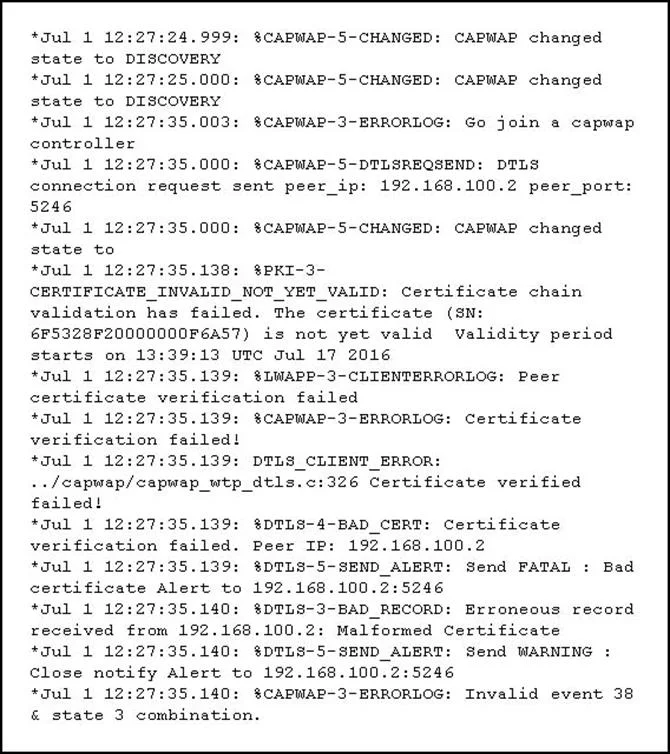
Refer to the exhibit. You are troubleshooting an AP that fails to join the WLC. What is a possible cause of the issue?
The correct answer is C. The certificate is expired. If an AP fails to join a WLC, an expired certificate on either device is a common cause because certificates are required to establish the secure CAPWAP communication channel.
Question
Refer to the exhibit. You are troubleshooting an AP that fails to join the WLC. What is a possible cause of the issue?
Exhibit
Options
- AThe WLC has the wrong time.
- BThere is a regulatory domain mismatch.
- CThe certificate is expired.
- DThere is an invalid management interface.
How the community answered
(45 responses)- A11% (5)
- B4% (2)
- C78% (35)
- D7% (3)
Why each option
If an AP fails to join a WLC, an expired certificate on either device is a common cause because certificates are required to establish the secure CAPWAP communication channel.
While an incorrect time can sometimes impact certificate validity checks if outside the valid time range, an expired certificate is a direct and specific cause of secure communication failure.
A regulatory domain mismatch primarily prevents an AP from transmitting radio signals, but it generally allows the AP to join the WLC, just not operate fully.
Access points and Wireless LAN Controllers (WLCs) utilize certificates to establish a secure CAPWAP tunnel for communication and authentication. If the certificate on either the AP or the WLC is expired, the secure handshake will fail, preventing the AP from successfully joining the controller.
An invalid management interface on the WLC would prevent basic IP connectivity or management, but an AP join failure specifically points to secure communication or authentication problems once discovery occurs.
Concept tested: AP join failure - certificate expiration
Source: https://www.cisco.com/c/en/us/td/docs/wireless/controller/8-5/config-guide/b_cg85/b_cg85_chapter_010.html
Topics
Community Discussion
No community discussion yet for this question.