
300-370 · Question #16
Refer to the exhibit. Which statement about the join process of the access point is true?
The correct answer is C. The controller rejected most of the discovery requests from the AP because they were not. The access point failed to join the controller because the controller rejected most of the AP's discovery requests, indicating a failure during the initial discovery phase.
Question
Refer to the exhibit. Which statement about the join process of the access point is true?
Exhibit
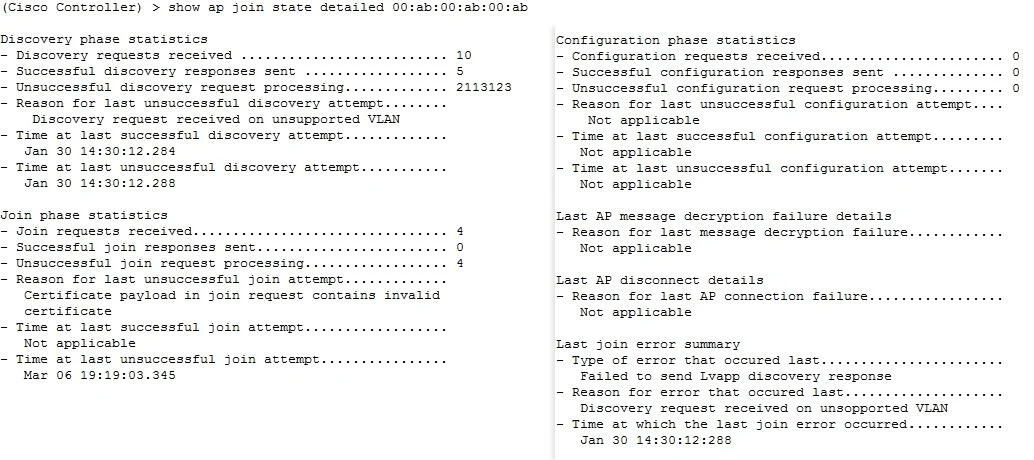
Options
- AThe time on the controller is outside of the certificates validity time interval, so the join phase
- BThe AP moved from this controller to its primary controller.
- CThe controller rejected most of the discovery requests from the AP because they were not
- DThe AP successfully joined the controller.
- EThe AP failed to join because the self-signed certificate of the AP on the controller was not
How the community answered
(55 responses)- A5% (3)
- B2% (1)
- C80% (44)
- D2% (1)
- E11% (6)
Why each option
The access point failed to join the controller because the controller rejected most of the AP's discovery requests, indicating a failure during the initial discovery phase.
Certificate validity issues typically manifest later in the join process, during DTLS tunnel establishment, not during the initial discovery request phase.
If the AP moved to its primary controller, this controller would not be actively rejecting discovery requests from it.
When a controller rejects most of an AP's discovery requests, it implies a problem during the initial communication stage where the AP attempts to locate and connect to a controller. This could be due to network filtering, misconfigured discovery methods, or security policies preventing successful processing of the requests, thus stopping the join process prematurely.
The rejection of discovery requests contradicts a successful AP join to the controller.
Self-signed certificate problems are usually related to the secure tunnel setup, not the initial discovery request phase itself.
Concept tested: Wireless AP controller discovery failure
Source: https://www.cisco.com/c/en/us/td/docs/wireless/controller/8-5/config-guide/b_cg85/b_cg85_chapter_0100000.html
Topics
Community Discussion
No community discussion yet for this question.