
300-370 · Question #144
Refer to the exhibit. An engineer has determined that during a recent controller failure, some access points did not fail over to their secondary controller, which has sufficient licenses for all…
The correct answer is A. The AP failover priority was not set high enough. When APs fail to fall over to a secondary controller, even with sufficient licenses and DNS A records, the most probable cause is an incorrect or insufficient AP failover priority configuration on the primary controller.
Question
Refer to the exhibit. An engineer has determined that during a recent controller failure, some access points did not fail over to their secondary controller, which has sufficient licenses for all APs. The controllers are not in a mobility group, but have A records for their hostnames in DNS. Using these high availability settings, which option is the most likely cause of this issue?
Exhibit
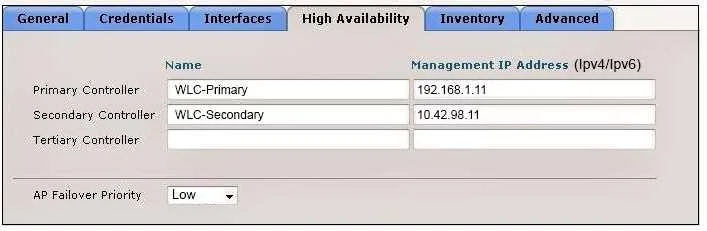
Options
- AThe AP failover priority was not set high enough.
- BThe controllers must be in the same mobility.
- CDNS hostnames are required to be FQDN.
- DThe secondary controller IP address is incorrect.
How the community answered
(52 responses)- A75% (39)
- B8% (4)
- C4% (2)
- D13% (7)
Why each option
When APs fail to fall over to a secondary controller, even with sufficient licenses and DNS A records, the most probable cause is an incorrect or insufficient AP failover priority configuration on the primary controller.
AP failover priority is a crucial setting on Cisco WLCs that determines the order in which APs attempt to join controllers in a high availability setup. If the primary controller has a higher priority and fails, but the AP's secondary controller priority is not correctly configured or is too low to be considered by the AP, it might not fail over, even if the secondary controller is available and has licenses.
Mobility groups are primarily for seamless roaming between controllers for clients, not for AP controller failover.
While FQDNs are best practice, the question states 'A records for their hostnames in DNS,' which implies that DNS resolution for the hostnames works, and FQDN vs. short name typically does not prevent failover if resolution occurs.
If the secondary controller's IP address were incorrect, the APs would not be able to reach it at all, and the problem would be more fundamental than just 'some access points did not fail over'.
Concept tested: WLC AP failover priority
Source: https://www.cisco.com/c/en/us/td/docs/wireless/controller/8-0/configuration-guide/b_cg80/b_cg80_chapter_01001.html
Topics
Community Discussion
No community discussion yet for this question.