
300-370 · Question #10
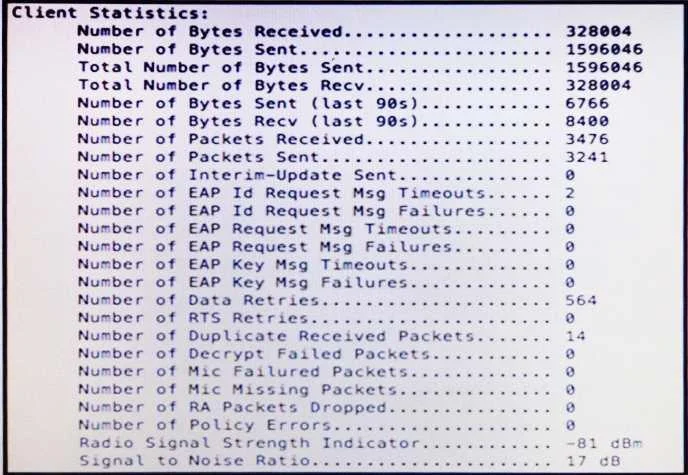
Refer to the exhibit. An engineer is troubleshooting access point placement issues and suspects that poor placement is causing connectivity issues. When running the show client detail <mac> command…
The correct answer is D. low ratio signal strength indicator. A low ratio signal strength indicator, such as Received Signal Strength Indicator (RSSI) or Signal-to-Noise Ratio (SNR), is a direct indication of poor access point placement.
Question
Refer to the exhibit. An engineer is troubleshooting access point placement issues and suspects that poor placement is causing connectivity issues. When running the show client detail <mac> command, the engineer notices this output. Which option indicates poor access point placement?
Exhibit
Options
- Aexcessive number of bytes sent compared to bytes received
- Bhigh signal-to-noise ratio
- Cexcessive number of data retries
- Dlow ratio signal strength indicator
- Eduplicate received packets
- Fpoor statistics for the last 90 seconds
How the community answered
(25 responses)- A4% (1)
- C4% (1)
- D72% (18)
- E12% (3)
- F8% (2)
Why each option
A low ratio signal strength indicator, such as Received Signal Strength Indicator (RSSI) or Signal-to-Noise Ratio (SNR), is a direct indication of poor access point placement.
An excessive number of bytes sent compared to bytes received typically indicates an application-level issue or asymmetrical data flow, not necessarily poor AP placement.
A high signal-to-noise ratio (SNR) is a desirable condition, indicating a strong signal relative to background noise, which suggests good AP placement, not poor.
Excessive number of data retries is a symptom often caused by poor signal quality (like low RSSI/SNR), but low signal strength is the more direct and fundamental indicator of poor placement.
A low ratio signal strength indicator (RSSI or SNR) directly implies that the client is receiving a weak signal from the access point, which is a primary indicator of poor access point placement or excessive distance from the AP. Weak signal strength frequently leads to unreliable connections, slow speeds, and increased retransmissions.
Duplicate received packets can be caused by various network issues like improper spanning-tree configuration or faulty hardware, but it is not typically a direct result of poor AP placement.
'Poor statistics for the last 90 seconds' is a vague statement that does not specify which statistics are poor, making it unhelpful for diagnosing specific AP placement issues.
Concept tested: Wireless Client Signal Strength and AP Placement
Source: https://www.cisco.com/c/en/us/support/docs/wireless/5500-series-wireless-controllers/115998-client-roam-troubleshoot-00.html
Topics
Community Discussion
No community discussion yet for this question.