
300-320 · Question #701
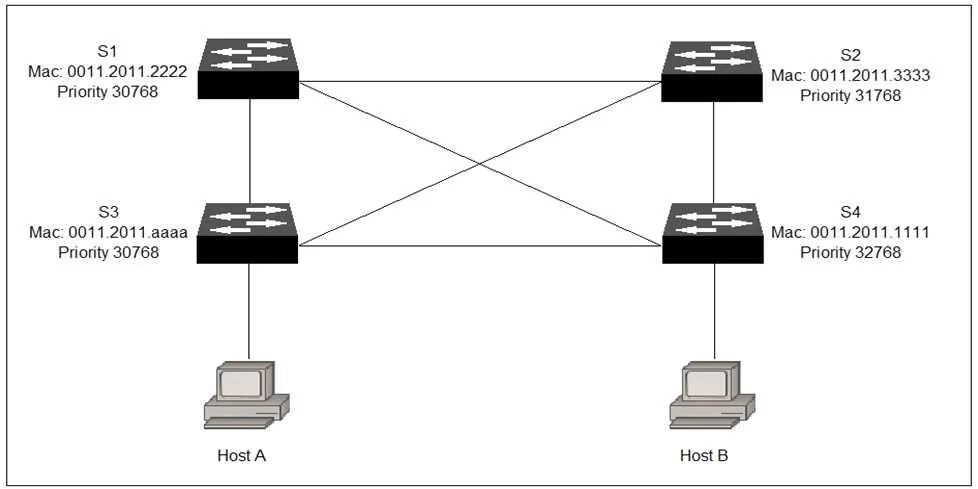
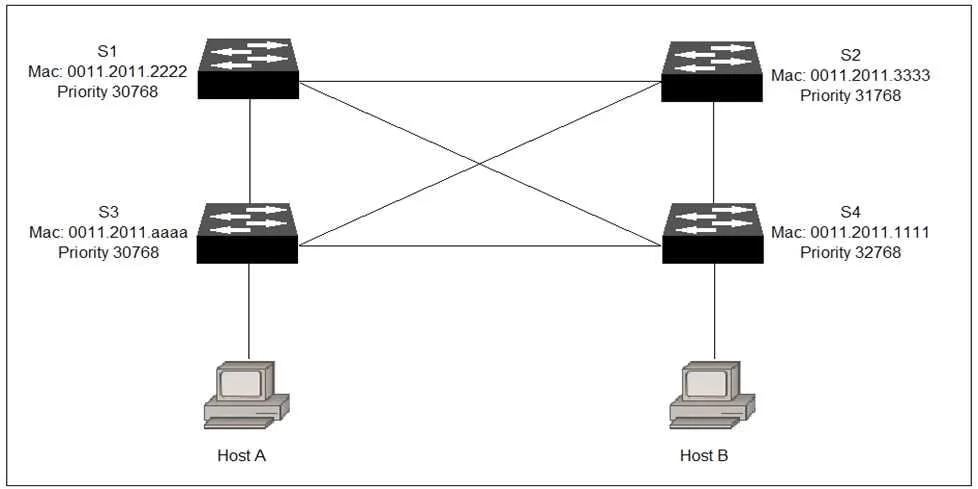
Refer to the exhibit. The network uses STP. All switches use the default priority and have the same bandwidth. Which description of the network is true?
The correct answer is D. The redundant links between the switches are blocked. The core purpose of Spanning Tree Protocol (STP) is to prevent Layer 2 loops in redundant switch topologies. When redundant links exist between switches, STP elects a root bridge and then places redundant (non-root, non-designated) ports into a Blocking state. This means…
Question
Refer to the exhibit. The network uses STP. All switches use the default priority and have the same bandwidth. Which description of the network is true?
Exhibits
Options
- AS3 is elected as the root bridge
- BS2 is elected as the root bridge
- CHost A can always reach host B through S1
- DThe redundant links between the switches are blocked
How the community answered
(29 responses)- A3% (1)
- B7% (2)
- C3% (1)
- D86% (25)
Explanation
The core purpose of Spanning Tree Protocol (STP) is to prevent Layer 2 loops in redundant switch topologies. When redundant links exist between switches, STP elects a root bridge and then places redundant (non-root, non-designated) ports into a Blocking state. This means traffic cannot traverse those ports, eliminating the loop. Options A and B cannot be determined without knowing the MAC addresses of S2 and S3 (since default priority is the same for all, the lowest MAC address wins root bridge election - this requires the exhibit). Option C is incorrect because STP may reroute traffic around failed links, and the active path may not always go through S1. Option D is correct because STP's fundamental mechanism is to block redundant links to maintain a loop-free topology.
Topics
Community Discussion
No community discussion yet for this question.