
300-320 · Question #597
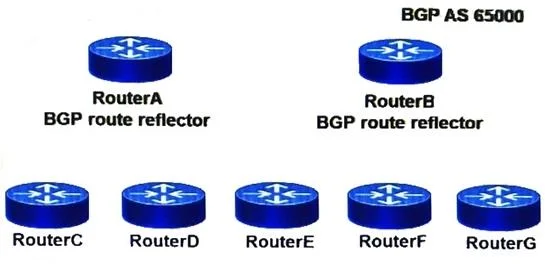
Refer to the exhibit. RouterA and RouterB are router reflectors. The other five routers are route reflector client of the both RouterA and RouterB. How many BGP peering sessions are needed to create…
The correct answer is C. 11. With two Route Reflectors (RR-A and RR-B) and five clients that peer with both RRs, the session count is: RR-A ↔ RR-B = 1 session (RRs must peer with each other to exchange client routes); RR-A ↔ each of 5 clients = 5 sessions; RR-B ↔ each of 5 clients = 5 sessions. Total: 1 +…
Question
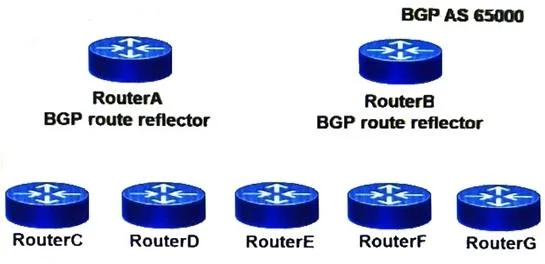
Refer to the exhibit. RouterA and RouterB are router reflectors. The other five routers are route reflector client of the both RouterA and RouterB. How many BGP peering sessions are needed to create full connectivity inside the network?
Exhibits
Options
- A6
- B10
- C11
- D21
How the community answered
(27 responses)- A4% (1)
- B7% (2)
- C85% (23)
- D4% (1)
Explanation
With two Route Reflectors (RR-A and RR-B) and five clients that peer with both RRs, the session count is: RR-A ↔ RR-B = 1 session (RRs must peer with each other to exchange client routes); RR-A ↔ each of 5 clients = 5 sessions; RR-B ↔ each of 5 clients = 5 sessions. Total: 1 + 5 + 5 = 11 sessions. A true full mesh of all 7 routers would require 7×6/2 = 21 sessions (D). The RR design reduces this to 11 while still providing full reachability, since each RR reflects routes between its clients and to the other RR.
Topics
Community Discussion
No community discussion yet for this question.