
300-320 · Question #46
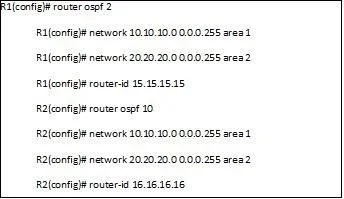
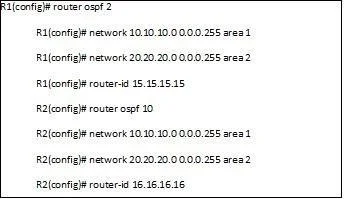
Refer to the exhibit. Based on the configuration, why are routers R1 and R2 not exchanging OSPF routes?
The correct answer is B. There is no backbone area configured. OSPF requires a backbone area (Area 0) to be present in any multi-area design. All non-backbone areas must connect directly to Area 0 for inter-area routing to work. If the configuration shows routers placed only in non-backbone areas (e.g., Area 1 and Area 2) with no Area 0…
Question
Refer to the exhibit. Based on the configuration, why are routers R1 and R2 not exchanging OSPF routes?
Exhibits
Options
- AThe OSPF process numbers are different.
- BThere is no backbone area configured.
- CThe router IDs are different.
- DOSPF is not enabled on the interfaces.
How the community answered
(23 responses)- A13% (3)
- B74% (17)
- C9% (2)
- D4% (1)
Explanation
OSPF requires a backbone area (Area 0) to be present in any multi-area design. All non-backbone areas must connect directly to Area 0 for inter-area routing to work. If the configuration shows routers placed only in non-backbone areas (e.g., Area 1 and Area 2) with no Area 0, OSPF adjacency will form but inter-area routes will not be exchanged. OSPF process numbers being different does not prevent adjacency - they are locally significant. Different router IDs are normal and expected. OSPF being enabled on interfaces is a separate issue that would prevent adjacency entirely, not just route exchange.
Topics
Community Discussion
No community discussion yet for this question.