
300-170 · Question #131
Refer to the exhibit. Which action do you take to ensure that both endpoints are within the same subnet?
The correct answer is B. Normalize the encapsulation by using the Same bridge domain. To ensure endpoints are in the same subnet within ACI, they must be part of the same bridge domain, which provides the Layer 2 forwarding and IP subnet context.
Question
Refer to the exhibit. Which action do you take to ensure that both endpoints are within the same subnet?
Exhibit
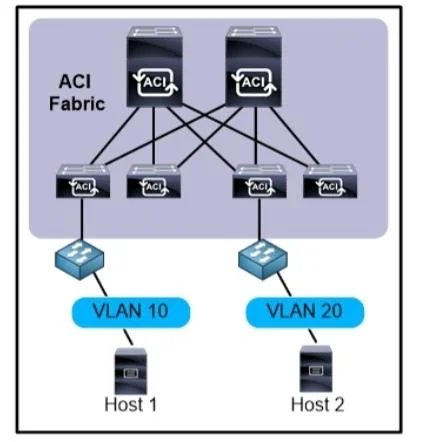
Options
- AStitch the two VLANs by using an attachable entity profile.
- BNormalize the encapsulation by using the Same bridge domain.
- CNormalize the encapsulation by using the same VRF
- DStitch the two VLANs by using an application network profile.
How the community answered
(24 responses)- A4% (1)
- B79% (19)
- C4% (1)
- D13% (3)
Why each option
To ensure endpoints are in the same subnet within ACI, they must be part of the same bridge domain, which provides the Layer 2 forwarding and IP subnet context.
Attachable Entity Profiles (AEPs) link physical infrastructure to logical configurations and specify VLAN pools, but they do not directly define Layer 2 forwarding or subnet membership for endpoints.
In ACI, a bridge domain defines a Layer 2 forwarding construct and is associated with one or more subnets. By placing both endpoints within the same bridge domain, they share the same Layer 2 broadcast domain and IP subnet, allowing them to communicate directly at Layer 2.
A VRF (Virtual Routing and Forwarding) instance provides Layer 3 isolation and routing context, but endpoints within the same subnet must first share the same Layer 2 bridge domain.
An application network profile (ANP) is a logical container for EPGs, contracts, and bridge domains, but it is not the direct component used to stitch VLANs or ensure same-subnet membership.
Concept tested: ACI bridge domain and subnet relationship
Source: https://www.cisco.com/c/en/us/td/docs/dcn/aci/apic/6x/config-guide/cisco-apic-config-guide-60x/m-configure-bridge-domains.html
Topics
Community Discussion
No community discussion yet for this question.