
300-170 · Question #105
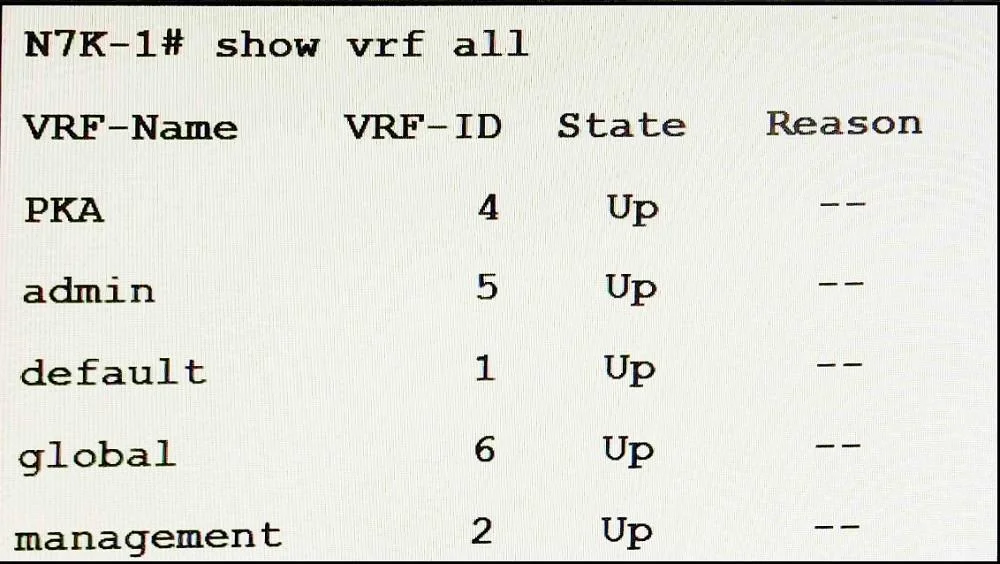
Refer to the exhibit. Which two VRFs does Cisco NX-OS create by default? (Choose two.)
The correct answer is A. default B. management. Cisco NX-OS automatically creates two VRFs by default: the 'default' VRF for regular data plane routing and the 'management' VRF for isolated out-of-band management traffic.
Question
Refer to the exhibit. Which two VRFs does Cisco NX-OS create by default? (Choose two.)
Exhibit
Options
- Adefault
- Bmanagement
- CPKA
- Dadmin
- Eglobal
How the community answered
(29 responses)- A90% (26)
- C3% (1)
- E7% (2)
Why each option
Cisco NX-OS automatically creates two VRFs by default: the 'default' VRF for regular data plane routing and the 'management' VRF for isolated out-of-band management traffic.
The 'default' VRF is the primary and global routing table in Cisco NX-OS, where all interfaces are placed by default if not explicitly assigned to another VRF.
The 'management' VRF is a dedicated, separate routing instance created by default in Cisco NX-OS to isolate management traffic from regular data plane traffic, enhancing security and operational stability.
'PKA' is not a standard VRF created by default in Cisco NX-OS; it does not correspond to a known default routing instance.
'admin' is not a standard VRF created by default in Cisco NX-OS; while 'admin' is sometimes used for roles or specific contexts, it is not a default VRF name.
'global' is not a VRF name used by default in Cisco NX-OS; the equivalent concept for the main routing table is the 'default' VRF.
Concept tested: Cisco NX-OS default VRFs
Source: https://www.cisco.com/c/en/us/td/docs/switches/datacenter/nexus7000/sw/interfaces/config/nxos/n7k_interfaces_config/n7k_interfaces_vrf.html
Topics
Community Discussion
No community discussion yet for this question.