
2V0-622 · Question #211
Refer to the Exhibit. An administrator is troubleshooting intermittent poor performance of virtual machines in a vSphere 6.x cluster. Investigating esxtop data shows that the only statistic that…
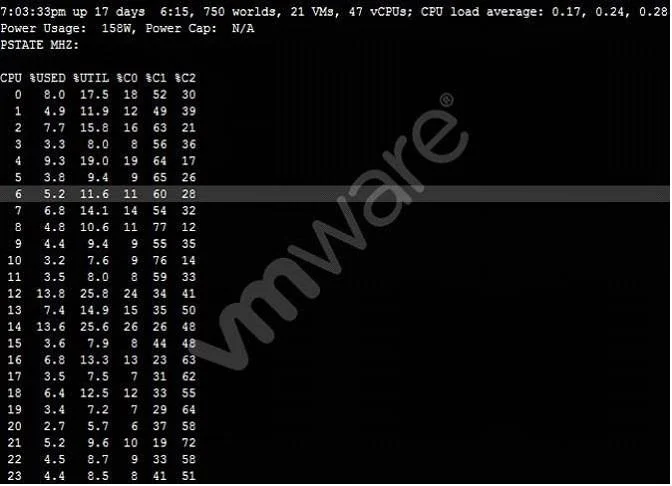
The correct answer is A. The active power policy is set to Low Power. B. The host has active Sleep States configured in the BIOS. High %CSTP in esxtop combined with a Low Power active policy and BIOS-level Sleep States (C-states) indicates CPU throttling and wake latency are co-stopping vCPUs and degrading VM performance.
Question
Refer to the Exhibit. An administrator is troubleshooting intermittent poor performance of virtual machines in a vSphere 6.x cluster. Investigating esxtop data shows that the only statistic that stands out is %CSTP as depicted in Exhibit 1:
The administrator proceeds to switch to the Power Management screen and observes the data depicted in Exhibit 2:
Based on the information in the exhibits, which two configurations are probable causes of the poor performance? (Choose two.)
Exhibits
Options
- AThe active power policy is set to Low Power.
- BThe host has active Sleep States configured in the BIOS.
- CThe active power policy is set to High Performance.
- DThe host has active Power States configured in the BIOS.
How the community answered
(37 responses)- A57% (21)
- C30% (11)
- D14% (5)
Why each option
High %CSTP in esxtop combined with a Low Power active policy and BIOS-level Sleep States (C-states) indicates CPU throttling and wake latency are co-stopping vCPUs and degrading VM performance.
The Low Power active policy in vSphere instructs the host to aggressively throttle CPU frequency, reducing processing capacity and causing vCPUs in multi-vCPU VMs to desynchronize, which directly elevates %CSTP.
Active Sleep States (C-states) in the BIOS allow physical CPU cores to enter deep sleep when idle; the latency required to wake a halted core forces co-vCPUs to wait, which is reflected as increased %CSTP in esxtop.
High Performance policy disables power savings and keeps CPUs at maximum frequency, which would reduce co-stop wait times rather than cause them.
Power States (P-states/frequency scaling) are the mechanism already covered by the vSphere power policy; the relevant BIOS feature causing halt-based latency is C-states (Sleep States), not a generic 'Power States' option.
Concept tested: CPU co-stop (%CSTP) caused by power management C-states
Source: https://docs.vmware.com/en/VMware-vSphere/7.0/com.vmware.vsphere.resmgmt.doc/GUID-DAB1B5EF-4E5C-4046-8B8B-87F6A73E730F.html
Topics
Community Discussion
No community discussion yet for this question.