
2V0-622 · Question #208
Refer to the Exhibit. An administrator recently created a Virtual SAN but no Storage Policies were defined. A few virtual machines were deployed to this cluster. The administrator analyzes the…
The correct answer is A. Losing one cluster node will not affect data availability. B. Losing one Hard Disk in a cluster node will not affect data availability. With the default vSAN storage policy of Failures to Tolerate (FTT) = 1, the cluster maintains a second copy of all data, so losing a single node or a single disk does not cause data unavailability.
Question
Refer to the Exhibit. An administrator recently created a Virtual SAN but no Storage Policies were defined. A few virtual machines were deployed to this cluster. The administrator analyzes the default Virtual SAN policy as shown in the Exhibit. Based on the exhibit, which two statements are true? (Choose two.)
Exhibit
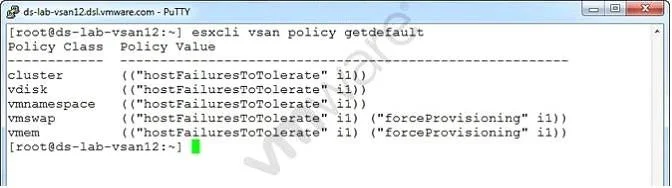
Options
- ALosing one cluster node will not affect data availability.
- BLosing one Hard Disk in a cluster node will not affect data availability.
- CCreating a virtual machine Swap file will fail if it violates default storage policy.
- DCreating a virtual machine will succeed even if it violates default storage policy.
How the community answered
(27 responses)- A74% (20)
- C7% (2)
- D19% (5)
Why each option
With the default vSAN storage policy of Failures to Tolerate (FTT) = 1, the cluster maintains a second copy of all data, so losing a single node or a single disk does not cause data unavailability.
FTT=1 means vSAN keeps two replicas of every object across different hosts; if one cluster node fails, the surviving replica on another host continues serving the data without interruption.
Because FTT=1 maintains replicas on separate hosts with separate disks, the failure of a single hard disk on any one node does not destroy all copies of the data, preserving availability.
vSAN swap files (.vswp) are assigned a special 'thin' storage policy by default that allows them to be created even when the cluster cannot fully satisfy the default FTT policy, so creation does not fail.
Virtual machine provisioning onto vSAN will fail if the cluster lacks sufficient resources (hosts, capacity) to satisfy the required FTT policy; it does not succeed silently when the policy is violated.
Concept tested: vSAN default storage policy FTT data availability
Source: https://docs.vmware.com/en/VMware-vSphere/7.0/com.vmware.vsphere.vsan.doc/GUID-E8EB4B51-E8E6-46F7-9DDE-7B7E4D60AF61.html
Topics
Community Discussion
No community discussion yet for this question.