
2V0-621 · Question #217
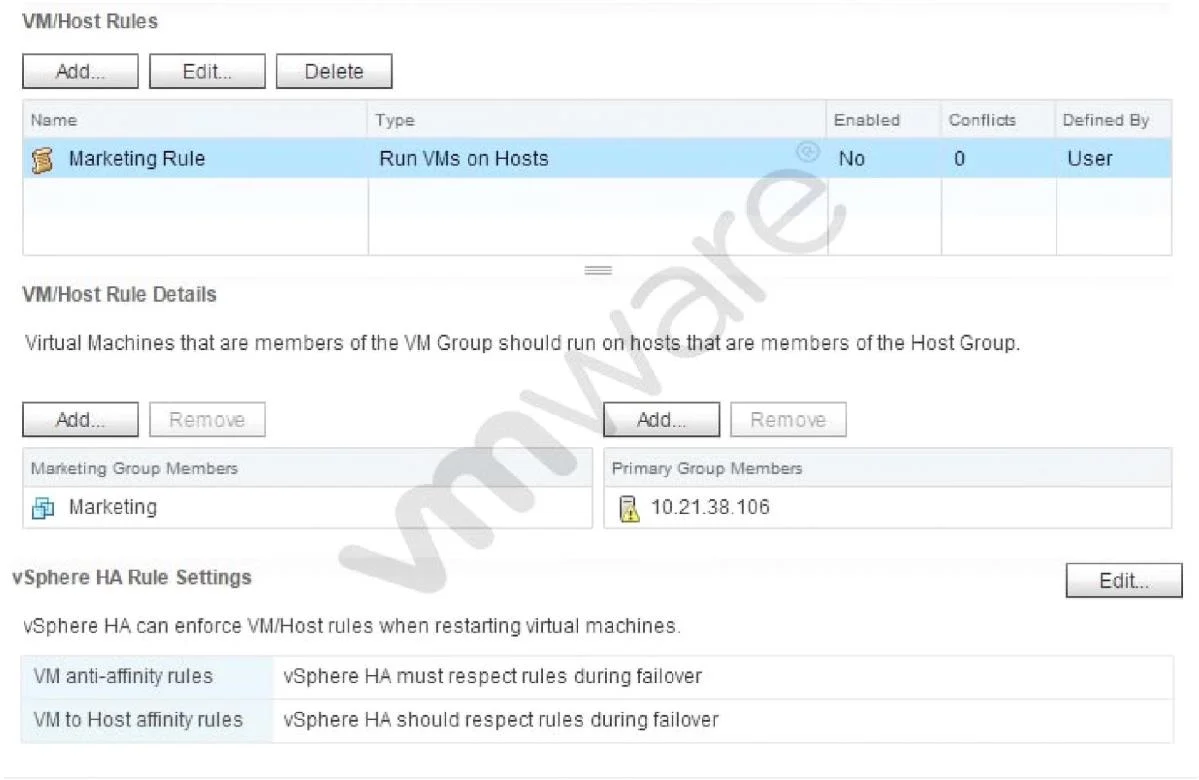
Refer to the Exhibit. An administrator manages a High Availability (HA)/Distributed Resource Scheduler (DRS)- enabled cluster and has configured the affinity rule shown in the Exhibit. Which two…
The correct answer is B. HA will failover Marketing to ESXi hosts that are not in the Host group. D. DRS will not attempt to keep Marketing on the ESXi host 10.21.28.106. This question tests understanding of how vSphere HA and DRS handle VM-Host affinity rules differently, and how subtle IP address differences in answer choices can indicate whether a host is actually part of the configured host group.
Question
Refer to the Exhibit. An administrator manages a High Availability (HA)/Distributed Resource Scheduler (DRS)- enabled cluster and has configured the affinity rule shown in the Exhibit. Which two statements best describe the configuration shown in the exhibit? (Choose two.)
Exhibit
Options
- AHA will not failover Marketing to ESXi hosts that are not in the Host Group.
- BHA will failover Marketing to ESXi hosts that are not in the Host group.
- CDRS will attempt to keep Marketing on the ESXi host 10.21.38.106.
- DDRS will not attempt to keep Marketing on the ESXi host 10.21.28.106.
How the community answered
(36 responses)- A22% (8)
- B67% (24)
- C11% (4)
Why each option
This question tests understanding of how vSphere HA and DRS handle VM-Host affinity rules differently, and how subtle IP address differences in answer choices can indicate whether a host is actually part of the configured host group.
HA only enforces placement restrictions for 'Must' (hard) rules - a 'Should' (soft) rule is a preference hint for DRS and is explicitly ignored by HA during failover, so HA can and will use any available host.
When a VM-Host affinity rule is configured as a 'Should' (soft) rule rather than a 'Must' (hard) rule, HA ignores the rule entirely during failover and will place the VM on any available host, including hosts outside the designated host group. This is by design so that VM availability is not sacrificed for placement preferences during a failure event.
Option C references 10.21.38.106, which is the host in the configured Host Group, but DRS VM-Host affinity rules operate at the Host Group level as a whole rather than pinning a VM to one specific host within the group, and the Should rule further means this is only a best-effort preference.
The IP address in option D is 10.21.28.106, which is a different address from the host configured in the Host Group (10.21.38.106). Because this host is not a member of the affinity rule's host group, DRS will not attempt to place or keep the Marketing VM on this specific host.
Concept tested: vSphere DRS and HA behavior with Should vs Must affinity rules
Source: https://docs.vmware.com/en/VMware-vSphere/7.0/com.vmware.vsphere.resmgmt.doc/GUID-793013E2-0976-43B7-9A00-340FA76859D0.html
Topics
Community Discussion
No community discussion yet for this question.