nerdexam
Broadcom-VMware

2V0-41.24 · Question #63

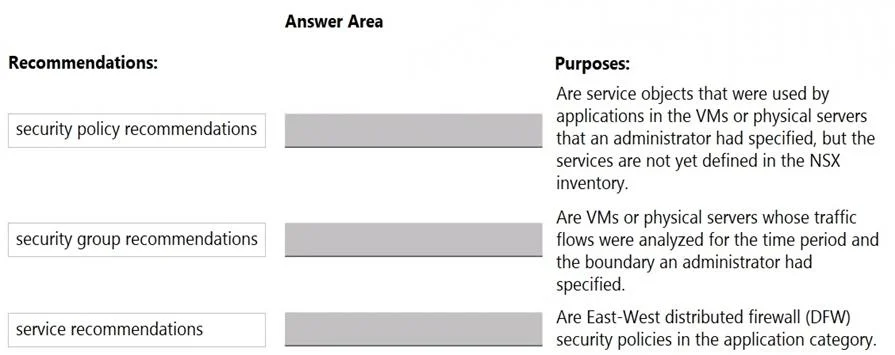
Drag and Drop Question Match the NSX Intelligence recommendations with their correct purpose. Answer:

The correct answer is service recommendations; security group recommendations; security policy recommendations. NSX Intelligence Recommendations - Explained NSX Intelligence analyzes east-west traffic flows across your NSX environment and generates three types of recommendations. They follow a logical dependency order - each layer depends on the one before it. --- 1. Service…

Section 5 – NSX Troubleshooting and Operations

Question

Drag and Drop Question Match the NSX Intelligence recommendations with their correct purpose. Answer:

Exhibit
2V0-41.24 question #63 exhibit

Answer Area

Drag items

security policy recommendationssecurity group recommendationsservice recommendations

Correct arrangement

  • service recommendations
  • security group recommendations
  • security policy recommendations

Explanation

NSX Intelligence Recommendations - Explained

NSX Intelligence analyzes east-west traffic flows across your NSX environment and generates three types of recommendations. They follow a logical dependency order - each layer depends on the one before it.


1. Service Recommendations (Position 1 - Foundation)

Purpose: Identifies which ports and protocols are actually being used in your environment based on observed traffic flows.

Why first: You cannot meaningfully group workloads or write firewall rules without first knowing what services are running. NSX Intelligence inspects traffic and recommends which services (e.g., TCP/443, UDP/53) should be formally defined.

Dependency: Everything else builds on this.


2. Security Group Recommendations (Position 2 - Grouping)

Purpose: Recommends how to logically group workloads (VMs, pods) based on their observed communication patterns.

Why second: Once you know what services exist, you can identify which workloads communicate similarly and should be grouped together. Groups define who the policy applies to.

Dependency: Requires services to be identified first so grouping is based on meaningful traffic patterns.


3. Security Policy Recommendations (Position 3 - Enforcement)

Purpose: Recommends the actual distributed firewall rules - defining what traffic is permitted between groups using the defined services.

Why last: Policies are the enforcement mechanism. They reference groups (who) and services (what), so both must exist before policies can be meaningfully constructed.


Common Misconceptions

MistakeReality
Jumping straight to policy recommendationsPolicies without groups/services produce overly broad or broken rules
Treating all three as independentThey have strict dependencies: services → groups → policies
Confusing "group" with "policy"Groups define membership; policies define allowed/denied traffic between groups

Mental model: Think of it as discover → organize → enforce.

Topics

#NSX Intelligence#micro-segmentation#recommendations#policy

Community Discussion

No community discussion yet for this question.

Full 2V0-41.24 Practice