
200-901 · Question #589
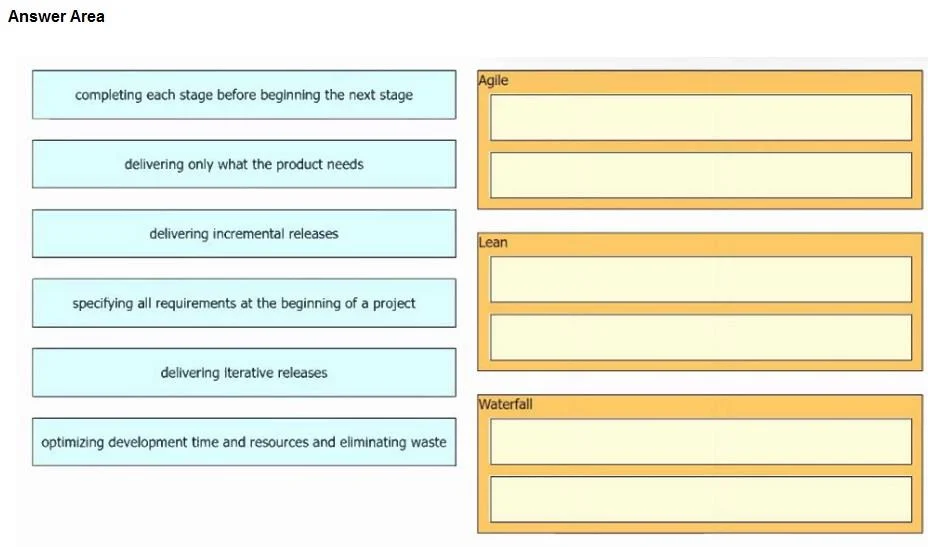
Drag and Drop Question Drag and drop the characteristics from the left onto the software development methods on the right. Answer:
The correct answer is delivering only what the product needs; delivering incremental releases; completing each stage before beginning the next stage; optimizing development time and resources and eliminating waste; specifying all requirements at the beginning of a project; delivering iterative releases. This question tests the ability to distinguish between the core characteristics of Agile, Lean, and Waterfall software development methodologies by correctly matching features to each method based on the provided solution.
Question
Drag and Drop Question Drag and drop the characteristics from the left onto the software development methods on the right. Answer:
Exhibit
Answer Area
Drag items
Correct arrangement
- delivering only what the product needs
- delivering incremental releases
- completing each stage before beginning the next stage
- optimizing development time and resources and eliminating waste
- specifying all requirements at the beginning of a project
- delivering iterative releases
Explanation
This question tests the ability to distinguish between the core characteristics of Agile, Lean, and Waterfall software development methodologies by correctly matching features to each method based on the provided solution.
Approach. Based on the provided answer image, the correct interactions are as follows:
-
Drag 'delivering only what the product needs' to Agile.
- Reason: Agile methodologies prioritize delivering value to the customer by focusing on essential features (Minimum Viable Product) and continuously incorporating feedback, thus avoiding unnecessary work.
-
Drag 'delivering incremental releases' to Agile.
- Reason: Agile approaches break down work into short cycles (sprints or iterations) to deliver small, functional pieces of the product frequently, allowing for early feedback and continuous adaptation.
-
Drag 'completing each stage before beginning the next stage' to Lean.
- Reason: While often associated with the strict sequential nature of Waterfall, in a Lean context, this emphasizes ensuring quality and readiness at each step of the value stream (building quality in) before work is 'pulled' to the next stage. This prevents defects and rework, which are forms of waste.
-
Drag 'optimizing development time and resources and eliminating waste' to Lean.
- Reason: This is the foundational principle of Lean software development, adapted from Lean manufacturing, which aims to maximize customer value by systematically identifying and eliminating all forms of waste in the development process.
-
Drag 'specifying all requirements at the beginning of a project' to Waterfall.
- Reason: The Waterfall model is characterized by a strong emphasis on upfront planning, where all requirements are gathered and documented extensively before proceeding to design and development phases.
-
Drag 'delivering iterative releases' to Waterfall.
- Reason: Although 'iterative releases' are more commonly associated with Agile or other iterative models, the provided answer maps this to Waterfall. In some interpretations, a large Waterfall project might be broken into phases that could be seen as iterations, or it might imply internal cycles of review and rework within phases, though it's less direct than a multi-release iterative approach.
Common mistakes.
- common_mistake. A common mistake involves confusing characteristics that might seem similar across methodologies, especially between Agile and Lean, or misinterpreting 'iterative' in the context of Waterfall.
-
Confusing 'incremental' and 'iterative': Many test-takers correctly identify Agile as both incremental and iterative. However, the question assigns 'delivering incremental releases' to Agile and 'delivering iterative releases' to Waterfall. This might be confusing, as 'iterative releases' (meaning multiple functional releases through a feedback loop) are a hallmark of Agile, not typically Waterfall. Placing 'delivering iterative releases' under Agile would be a common and generally accepted understanding, but it contradicts the provided answer key here.
-
Misplacing 'completing each stage before beginning the next stage': This characteristic is often strongly associated with Waterfall's strict phase gates and sequential progress. Incorrectly assigning it to Waterfall instead of Lean (as per the provided answer) would be a common error. The Lean interpretation focuses on quality gates and flow management to prevent waste, rather than strict sequential processing.
-
Mixing Lean and Agile principles: Both methodologies aim for efficiency and value. For example, 'delivering only what the product needs' (Agile) might mistakenly be put under Lean due to Lean's focus on eliminating waste, including unnecessary features. However, Agile directly addresses this through MVP and frequent feedback. Conversely, placing 'optimizing development time and resources and eliminating waste' (Lean) under Agile might occur due to Agile's focus on efficient sprints, but waste elimination is the core tenet of Lean.
Concept tested. Understanding the core principles, characteristics, and distinguishing features of major software development methodologies: Agile, Lean, and Waterfall.
Topics
Community Discussion
No community discussion yet for this question.