
200-901 · Question #548
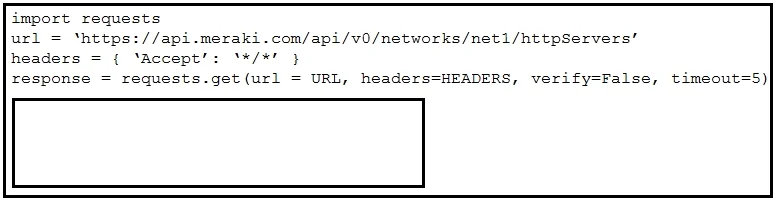
Refer to the exhibit. A developer created a Python script by using the Cisco Meraki API. The solution must: - Obtain a list of HTTP servers for a network named "net1". - Print the response body if…
The correct answer is A. except requests.Timeout as e: print("Timeout Error: {}". Format(e)) if response.status_code ==200: print(response.text). Properly catching a requests timeout requires the module-prefixed exception class, capturing the instance with 'as', and interpolating the variable - not a string literal - into the printed message.
Question
Refer to the exhibit. A developer created a Python script by using the Cisco Meraki API. The solution must:
- Obtain a list of HTTP servers for a network named "net1".
- Print the response body if the HTTP status code is 200.
- Handle the timeout requests as exceptions, and print Timeout Error
next to the exception to stdout. Which block of code completes the script? A. B. C. D.
Exhibit
Options
- Aexcept requests.Timeout as e: print("Timeout Error: {}". Format(e)) if response.status_code ==200: print(response.text)
- Bexcept Timeout as exception: print("Timeout Error") if status_code == 200: print(response.text)
- Cexcept requests Timeout: print("Timeout Error") if response.status_code == 200: print(response)
- Dexcept requests.Timeout as exception: print("Timeout Error: exception") if response.status_code == 200: print(response)
How the community answered
(50 responses)- A84% (42)
- B10% (5)
- C2% (1)
- D4% (2)
Why each option
Properly catching a requests timeout requires the module-prefixed exception class, capturing the instance with 'as', and interpolating the variable - not a string literal - into the printed message.
except requests.Timeout as e correctly references the Timeout exception from the requests module and binds the exception instance to e. The call print("Timeout Error: {}".format(e)) interpolates the actual exception object so its details appear next to the label, satisfying the requirement to print Timeout Error next to the exception. The subsequent check for response.status_code == 200 and print(response.text) correctly prints the response body when the request succeeds.
except Timeout as exception omits the required requests. module prefix, which would raise a NameError at runtime, and if status_code == 200 references an undefined variable instead of response.status_code.
except requests Timeout is a syntax error because it is missing the dot separator between requests and Timeout, and the block prints the raw response object instead of response.text.
print("Timeout Error: exception") passes the string literal 'exception' rather than the captured exception variable, so the actual exception details are never included in the output.
Concept tested: Python requests module exception handling and response body output
Source: https://requests.readthedocs.io/en/latest/user/quickstart/#errors-and-exceptions
Topics
Community Discussion
No community discussion yet for this question.