
200-901 · Question #246
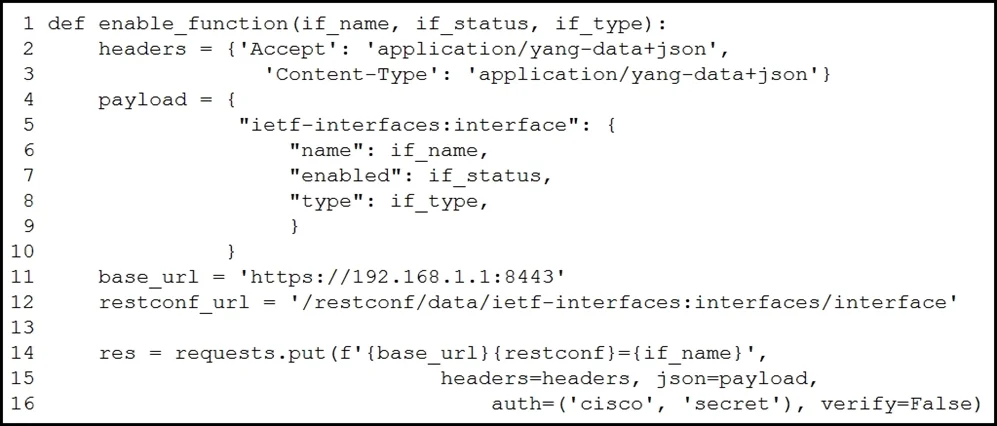
Refer to the exhibit. A network engineer wants to automate the port enable/disable process on specific Cisco switches. The engineer creates a script to send a request through RESTCONF and uses ietf…
The correct answer is A. enable_function(Loopback1, true, 'iana-if-type:softwareLoopback'). Options C and D both start with 'def', which is the Python keyword for defining a function, not calling one. The task requires calling the function, not defining it. Option B passes the arguments in the wrong order (interface type before interface name). Option A correctly…
Question
Refer to the exhibit. A network engineer wants to automate the port enable/disable process on specific Cisco switches. The engineer creates a script to send a request through RESTCONF and uses ietf as the YANG model and JSON as payload. Which command enables an interface named Loopback1?
Exhibit
Options
- Aenable_function(Loopback1, true, 'iana-if-type:softwareLoopback')
- Benable_function('iana-if-type:softwareLoopback', Loopback1, true,)
- Cdef enable_function('iana-if-type:softwareLoopback', Loopback1, false,)
- Ddef enable_function(Loopback1, true, 'iana-if-type:softwareLoopback')
How the community answered
(44 responses)- A84% (37)
- B9% (4)
- C5% (2)
- D2% (1)
Explanation
Options C and D both start with 'def', which is the Python keyword for defining a function, not calling one. The task requires calling the function, not defining it. Option B passes the arguments in the wrong order (interface type before interface name). Option A correctly calls the already-defined function with the proper argument order: interface name (Loopback1), enabled state (true to enable), and the IANA interface type ('iana-if-type:softwareLoopback'). This matches the IETF YANG model structure where the interface name, admin status, and type are required fields to enable a loopback interface via RESTCONF.
Topics
Community Discussion
No community discussion yet for this question.