
200-901 · Question #133
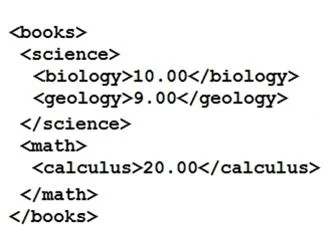
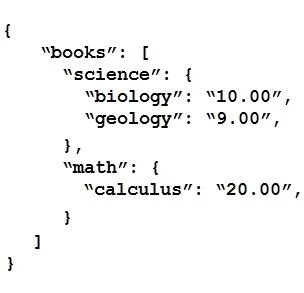
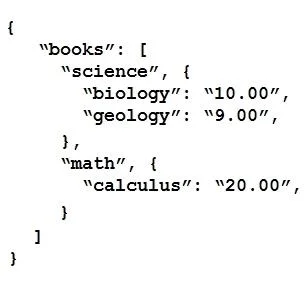
Refer to Exhibit. Which JSON is equivalent to the XML-encoded data? A. B. C. D.
The correct answer is B. { "books": { "science": { "biology": "10.00", "geology": "9.00" }, "math": { "calculus": "20.00" } } }. The correct answer is B. The XML structure shows a 'books' root element with two child categories: 'science' (containing 'biology' at 10.00 and 'geology' at 9.00) and 'math' (containing 'calculus' at 20.00). In the equivalent JSON, 'science' and 'math' should be sibling keys…
Question
Refer to Exhibit. Which JSON is equivalent to the XML-encoded data? A. B. C. D.
Exhibits
Options
- A[ { "books": { "science": { "biology": "10.00", "geology": "9.00" }, "math": { "calculus": "20.00" } } } ]
- B{ "books": { "science": { "biology": "10.00", "geology": "9.00" }, "math": { "calculus": "20.00" } } }
- C{ "books": { "science": { "biology": "10.00", "geology": "9.00", "math": { "calculus": "20.00" } } } }
- D{ "books": [ { "science": { "biology": "10.00", "geology": "9.00" }, "math": { "calculus": "20.00" } } ] }
How the community answered
(43 responses)- A12% (5)
- B79% (34)
- C7% (3)
- D2% (1)
Explanation
The correct answer is B. The XML structure shows a 'books' root element with two child categories: 'science' (containing 'biology' at 10.00 and 'geology' at 9.00) and 'math' (containing 'calculus' at 20.00). In the equivalent JSON, 'science' and 'math' should be sibling keys directly under 'books'. Answer B correctly represents this flat, parallel structure. Answer A is incorrect because it wraps the object in an array unnecessarily. Answer C is incorrect because it nests 'math' inside 'science', implying a parent-child relationship that doesn't exist in the XML. Answer D is incorrect because it places 'books' content inside an array with 'science' and 'math' as object properties of a single array element.
Topics
Community Discussion
No community discussion yet for this question.