
200-401 · Question #33
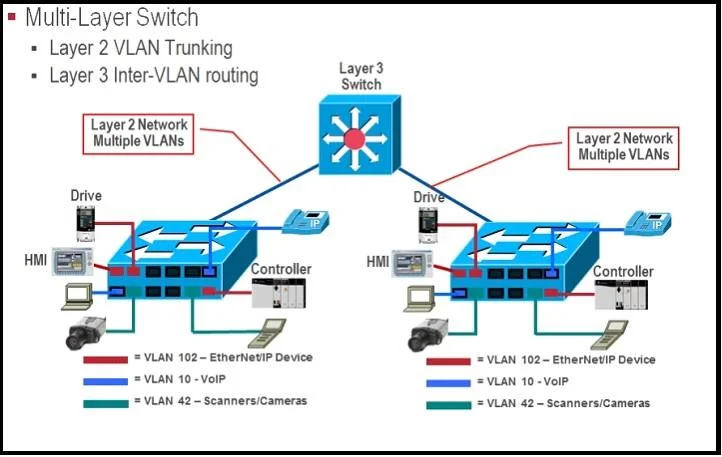
Refer to the exhibit. What are three traffic and interconnection requirements for the devices in the exhibit? (Choose three.)
The correct answer is A. The EtherNet/IP drive connections are in a high-voltage area and need protection from D. EtherNet/IP drive traffic has high sensitivity to random drops, latency, and jitter. F. IEEE1588 and PTP are important for ensuring real-time synchronization. Options A, D, and F correctly capture real-world requirements for industrial EtherNet/IP deployments. Drive enclosures in high-voltage areas generate significant electromagnetic interference (EMI), so EtherNet/IP cabling and hardware must be shielded or protected accordingly…
Question
Refer to the exhibit. What are three traffic and interconnection requirements for the devices in the exhibit? (Choose three.)
Exhibit
Options
- AThe EtherNet/IP drive connections are in a high-voltage area and need protection from
- BEtherNet/IP devices such as the controller, drive, VoIP phone, and IP camera should be in the
- CCIP traffic has the highest bandwidth requirement so it needs the highest QoS setting.
- DEtherNet/IP drive traffic has high sensitivity to random drops, latency, and jitter.
- EReal-time motion control and VoIP traffic can share the same VLAN with the proper QoS setting.
- FIEEE1588 and PTP are important for ensuring real-time synchronization.
How the community answered
(33 responses)- A73% (24)
- B15% (5)
- C9% (3)
- E3% (1)
Explanation
Options A, D, and F correctly capture real-world requirements for industrial EtherNet/IP deployments. Drive enclosures in high-voltage areas generate significant electromagnetic interference (EMI), so EtherNet/IP cabling and hardware must be shielded or protected accordingly (A). Drive control traffic is time-critical - random packet drops, latency, and jitter can cause loss of motor control or trigger safety faults (D). IEEE 1588 / Precision Time Protocol (PTP) provides sub-microsecond clock synchronization across network devices, which is essential for coordinated motion control and time-stamped events (F).
Why the distractors are wrong:
- B is wrong because industrial EtherNet/IP devices (controllers, drives) should be segregated from IT devices like VoIP phones and cameras - mixing them risks security exposure and performance interference.
- C is wrong because CIP traffic is not high-bandwidth; it is small and periodic. Its QoS priority is driven by time-sensitivity, not bandwidth demand.
- E is wrong because real-time motion control and VoIP must be in separate VLANs - they have incompatible security profiles and mixing them is poor network design regardless of QoS.
Memory tip: Think "ADF = Always Defend the Factory" - Area protection from high voltage, Drive traffic is jitter-sensitive, and Frequency/time sync via 1588 keeps everything coordinated.
Topics
Community Discussion
No community discussion yet for this question.