
200-301 · Question #927
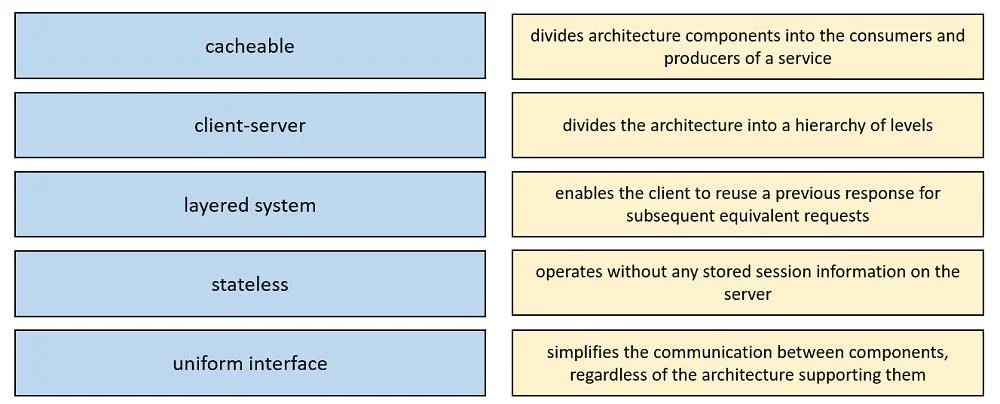
Drag and Drop Question Drag and drop the REST principles from the left onto their definitions on the right. Answer:
The correct answer is client-server; layered system; cacheable; stateless; uniform interface. The correct arrangement maps each REST principle to its definition based on the six core Fielding REST constraints: client-server separates UI concerns from data storage concerns; layered system means a client cannot tell whether it is connected directly to the end server or an…
Question
Exhibits
Answer Area
Drag items
Correct arrangement
- client-server
- layered system
- cacheable
- stateless
- uniform interface
Explanation
The correct arrangement maps each REST principle to its definition based on the six core Fielding REST constraints: client-server separates UI concerns from data storage concerns; layered system means a client cannot tell whether it is connected directly to the end server or an intermediary; cacheable requires responses to define themselves as cacheable or non-cacheable to improve efficiency; stateless means each request from client to server must contain all information needed to understand the request, with no session state stored server-side; and uniform interface centralizes and decouples the architecture by applying a generalized interface between components. These definitions are foundational to RESTful API design and are directly tied to Roy Fielding's original dissertation constraints.
Topics
Community Discussion
No community discussion yet for this question.