
200-301 · Question #918
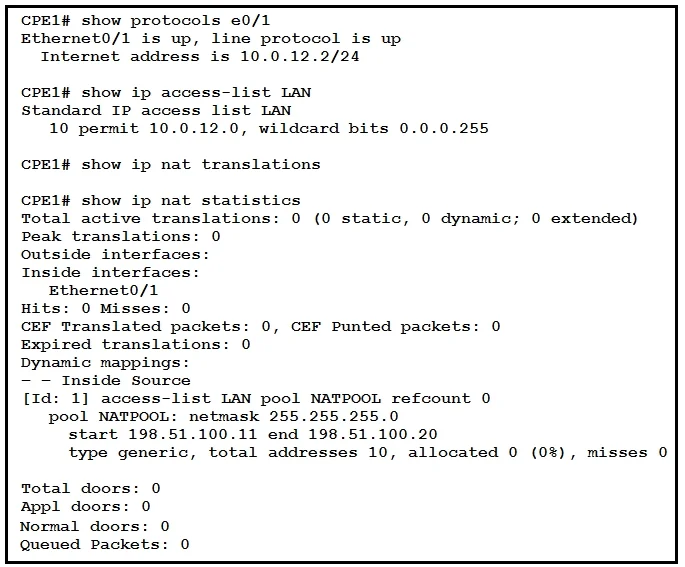
Refer to the exhibit. What is the next step to complete the implementation for the partial NAT configuration shown?
The correct answer is D. Configure the NAT outside interface. After configuring NAT rules and pools, the final crucial step for implementation is to specify which interfaces are 'inside' and 'outside' for address translation.
Question
Exhibits
Options
- AModify the access list for the internal network on e0/1.
- BReconfigure the static NAT entries that overlap the NAT pool.
- CApply the ACL to the pool configuration.
- DConfigure the NAT outside interface.
How the community answered
(26 responses)- A8% (2)
- B4% (1)
- C8% (2)
- D81% (21)
Why each option
After configuring NAT rules and pools, the final crucial step for implementation is to specify which interfaces are 'inside' and 'outside' for address translation.
Modifying an existing access list is typically a refinement or troubleshooting step, not the primary next step to complete a partial NAT implementation if the ACL is already defined for NAT matching.
Reconfiguring static NAT entries is a correction or modification task, not the immediate next step to initially enable NAT functionality on the interfaces.
ACLs are used to match traffic for dynamic NAT pools and are referenced within the `ip nat inside source` command, but they are not 'applied to the pool configuration' as a separate command to complete the implementation.
To complete a NAT configuration, the router must be explicitly told which interface connects to the internal (private) network using `ip nat inside` and which connects to the external (public) network using `ip nat outside`. Without designating an `ip nat outside` interface, the router cannot perform outbound address translations.
Concept tested: NAT interface configuration
Source: https://www.cisco.com/c/en/us/td/docs/ios/ipaddr/configuration/guide/iad_cfg.html
Topics
Community Discussion
No community discussion yet for this question.