
200-301 · Question #909
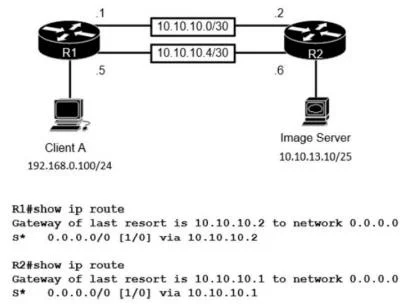
Refer to the exhibit. The image server and client A are running an application that transfers an extremely high volume of data between the two. An engineer is configuring a dedicated circuit between…
The correct answer is A. R1(config)#ip route 10.10.13.10 255.255.255.255 10.10.10.6. To force traffic only between specific hosts to use a new dedicated circuit, host-specific static routes must be configured on the routers, pointing to the next-hop on the new circuit.
Question
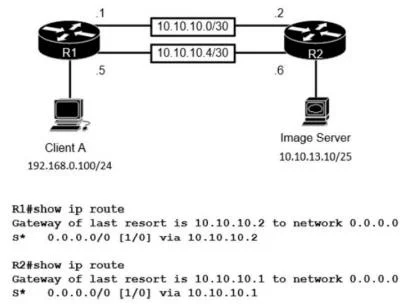
Refer to the exhibit. The image server and client A are running an application that transfers an extremely high volume of data between the two. An engineer is configuring a dedicated circuit between R1 and R2. Which set of commands must the engineer apply to the routers so that only traffic between the image server and client A is forces to use the new circuit?
Exhibits
Options
- AR1(config)#ip route 10.10.13.10 255.255.255.255 10.10.10.6
- BR1(config)#ip route 10.10.13.10 255.255.255.128 10.10.10.6
- CR1(config)#ip route 10.10.13.10 255.255.255.252 10.10.10.6
- DR1(config)#ip route 10.10.13.10 255.255.255.255 10.10.10.2
How the community answered
(23 responses)- A65% (15)
- B4% (1)
- C9% (2)
- D22% (5)
Why each option
To force traffic only between specific hosts to use a new dedicated circuit, host-specific static routes must be configured on the routers, pointing to the next-hop on the new circuit.
To ensure that *only* traffic for the Image Server (10.10.13.10) uses the new dedicated circuit, a host route with a `255.255.255.255` subnet mask is required. This specific route explicitly directs traffic for `10.10.13.10` towards the next-hop `10.10.10.6`, which is designated as the entry point to the new circuit from R1's perspective. A similar host route would also be needed for Client A to complete the setup.
Using a `/25` mask (`255.255.255.128`) creates a network route that covers a range of IP addresses, not just the specific host. This would force more traffic than just the Image Server's to use the new circuit, violating the 'only traffic between' requirement.
Using a `/30` mask (`255.255.255.252`) creates a network route that covers a range of IP addresses, not just the specific host. This would force more traffic than just the Image Server's to use the new circuit, violating the 'only traffic between' requirement.
While a host route (`255.255.255.255`) is correct for specificity, the specified next-hop `10.10.10.2` contradicts the implied correct next-hop `10.10.10.6` for the dedicated circuit, as indicated by the correct answer.
Concept tested: Static host routing for policy-based forwarding
Source: https://www.cisco.com/c/en/us/td/docs/ios-xml/ios/iproute_static/configuration/xe-3s/irs-xe-3s-book/irs-static-route-cfg.html
Topics
Community Discussion
No community discussion yet for this question.